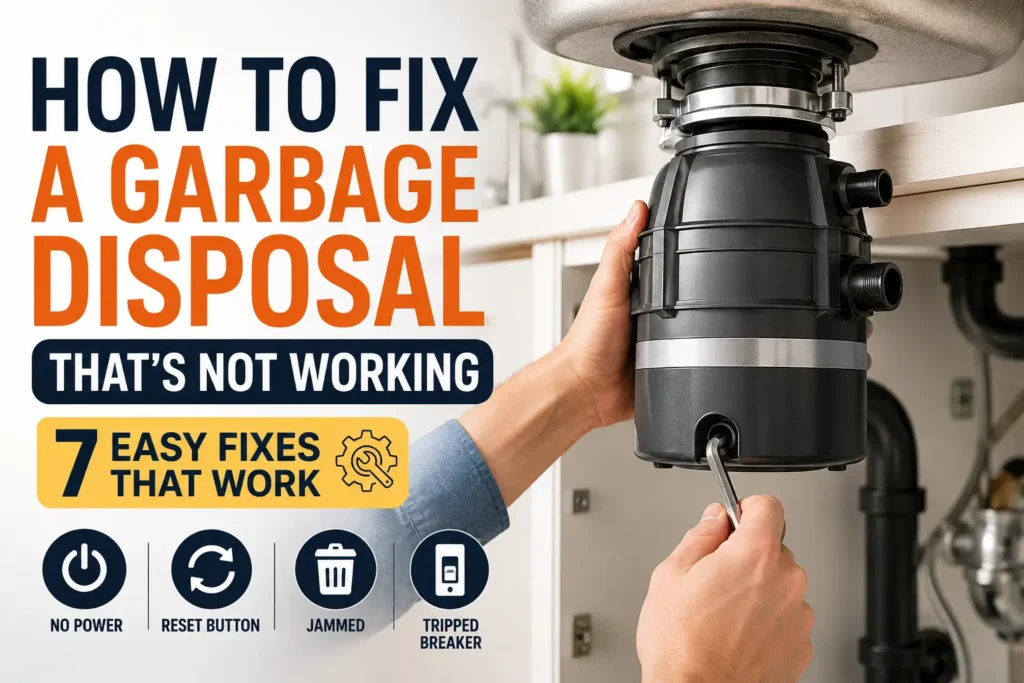
A garbage disposal that suddenly stops working can turn a simple kitchen cleanup into a frustrating problem. You may flip the switch and hear nothing, notice a humming sound, or find that the disposal runs but does not grind properly.
Learning how to fix a garbage disposal can help you solve many common problems without immediately replacing the unit.
The good news is that many garbage disposal problems are caused by simple issues such as a tripped reset button, a jammed grinding mechanism, a loose power connection, or an overloaded motor.
If you are wondering how to fix a garbage disposal, start with the easiest checks before assuming the unit needs to be replaced. The seven troubleshooting methods below can help you identify the problem and may get your disposal running again without an expensive repair.
Safety first: Always switch the garbage disposal off and disconnect its power before attempting to remove a jam or foreign object. Never put your hand or fingers inside the disposal. Manufacturers recommend using long-handled tongs or pliers instead.
Why Is My Garbage Disposal Not Working?
Before you start troubleshooting, pay attention to what happens when you try to turn the disposal on.
If it is completely silent, the problem may involve the power supply, reset button, switch, or circuit breaker.
If you hear a humming sound but the disposal does not spin, something may be preventing the grinding mechanism from moving.
If the disposal starts and then stops, its overload protection may have been triggered.
Knowing the symptom makes it much easier to determine how to fix a garbage disposal without taking apart components unnecessarily.
7 Easy Ways to Fix a Garbage Disposal
1. Check Whether the Garbage Disposal Has Power
Start with the simplest possibility: the disposal may not be receiving electricity.
Turn the wall switch off. If your disposal plugs into an outlet beneath the sink, check whether the plug has become loose or disconnected.
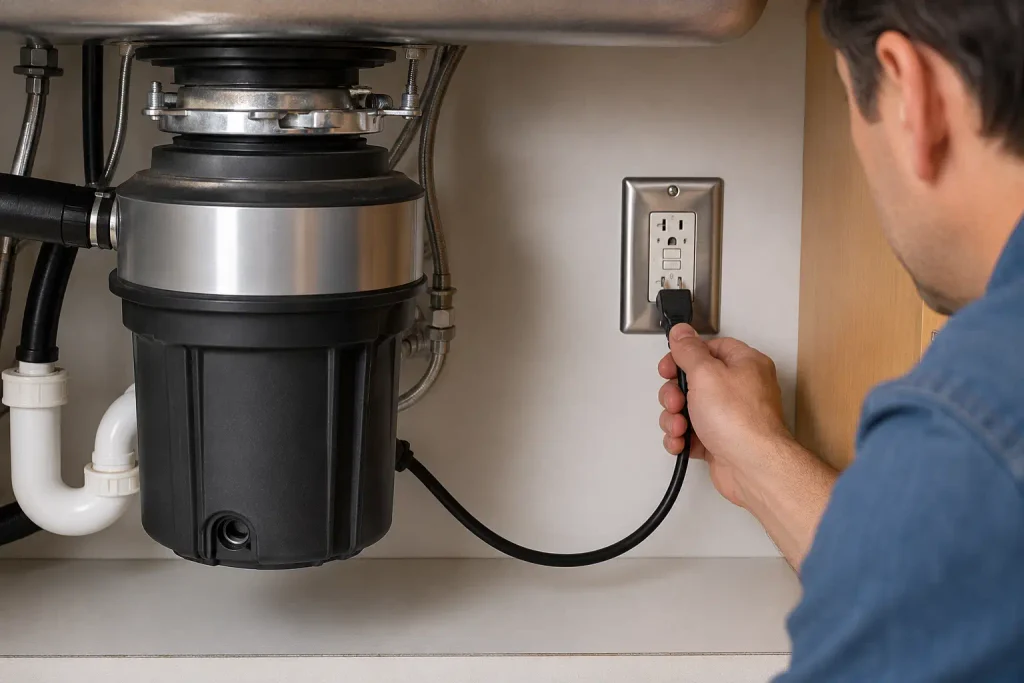
Also check whether a nearby GFCI outlet has tripped. If it has, reset it according to the outlet manufacturer’s instructions.
Next, look at your home’s electrical panel and check whether the circuit breaker supplying the disposal has tripped. A tripped breaker can prevent the unit from starting at all.
If you reset a breaker and it immediately trips again, stop troubleshooting and have the electrical problem inspected rather than repeatedly resetting it.
2. Press the Garbage Disposal Reset Button
Most garbage disposals have overload protection that shuts the motor down if it becomes overloaded or jammed. Depending on the model, there may be a manual reset button on the bottom or lower portion of the unit.
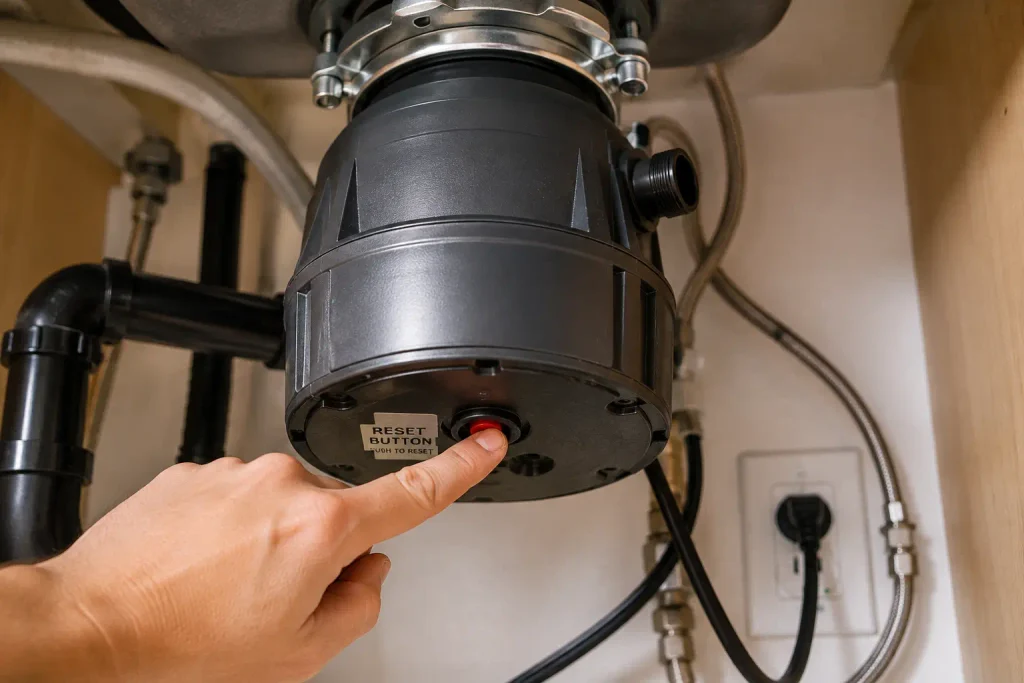
Turn the disposal switch off and allow the motor to cool.
Look underneath the disposal for a small reset button, which is commonly red.
Press the button gently. If it had popped out because the overload protector was triggered, resetting it may restore operation.
After resetting it, reconnect power and test the disposal.
This is one of the easiest things to try when learning how to fix a garbage disposal that suddenly stopped running.
When learning how to fix a garbage disposal, checking the reset button is one of the easiest troubleshooting steps.
3. Clear a Jammed Garbage Disposal
If the disposal makes a humming sound but does not grind, it may be jammed.
Do not keep running a humming disposal. Repeated attempts can cause the overload protection to trip.
Switch off and disconnect power to the disposal.
Many models have a wrench socket underneath the unit. Insert the manufacturer’s disposal wrench—or the appropriate Allen wrench if your model permits it—and gently move it back and forth.
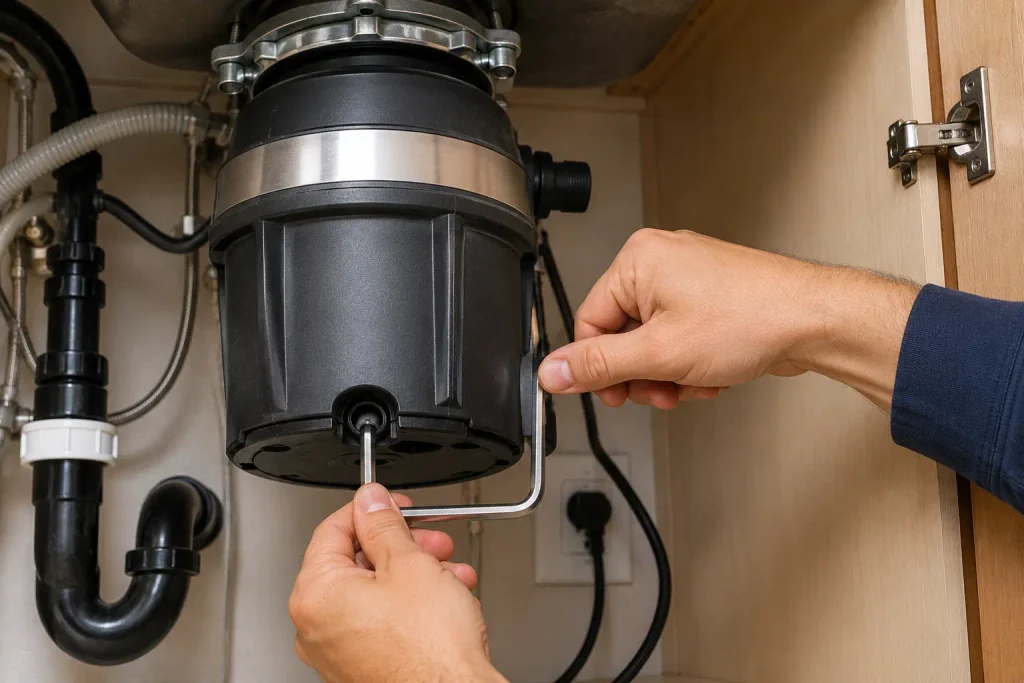
Continue until the mechanism begins moving freely.
Manufacturer instructions commonly recommend working the wrench back and forth to release the jam rather than forcing the unit.
Once the mechanism moves freely, remove the wrench before restoring power.
Understanding how to fix a garbage disposal also means knowing how to safely identify and clear a simple jam.
4. Remove Foreign Objects Safely
Sometimes a spoon, piece of metal, bone fragment, or another hard object falls into the disposal and prevents it from turning correctly.
First, completely disconnect the power.
Use a flashlight to look through the sink opening.
If you can clearly see an object, use long-handled tongs or pliers to remove it.
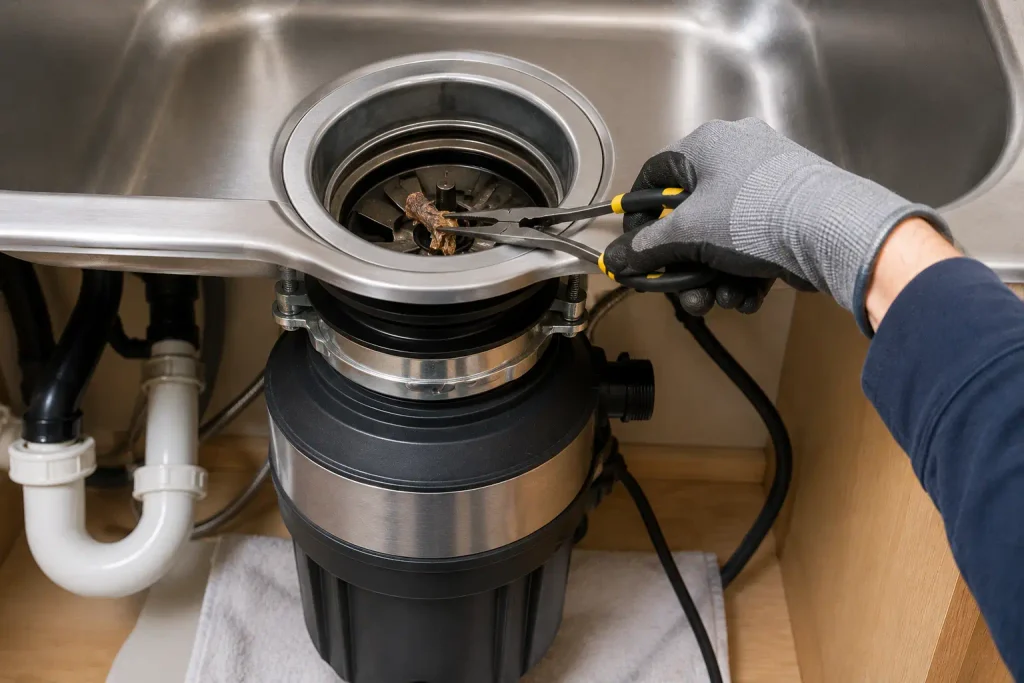
Never reach into the disposal with your fingers—even when you believe the power is off. Moen’s troubleshooting guidance specifically recommends disconnecting the power and using tongs or needle-nose pliers rather than your hand.
After removing the object, check that nothing else is obstructing the mechanism before restoring power.
5. Check the Circuit Breaker
If your garbage disposal remains completely silent after checking the plug and reset button, inspect the electrical panel.
Find the circuit breaker that supplies power to the kitchen or garbage disposal.
If the breaker has tripped, move it fully to the OFF position and then back to ON.
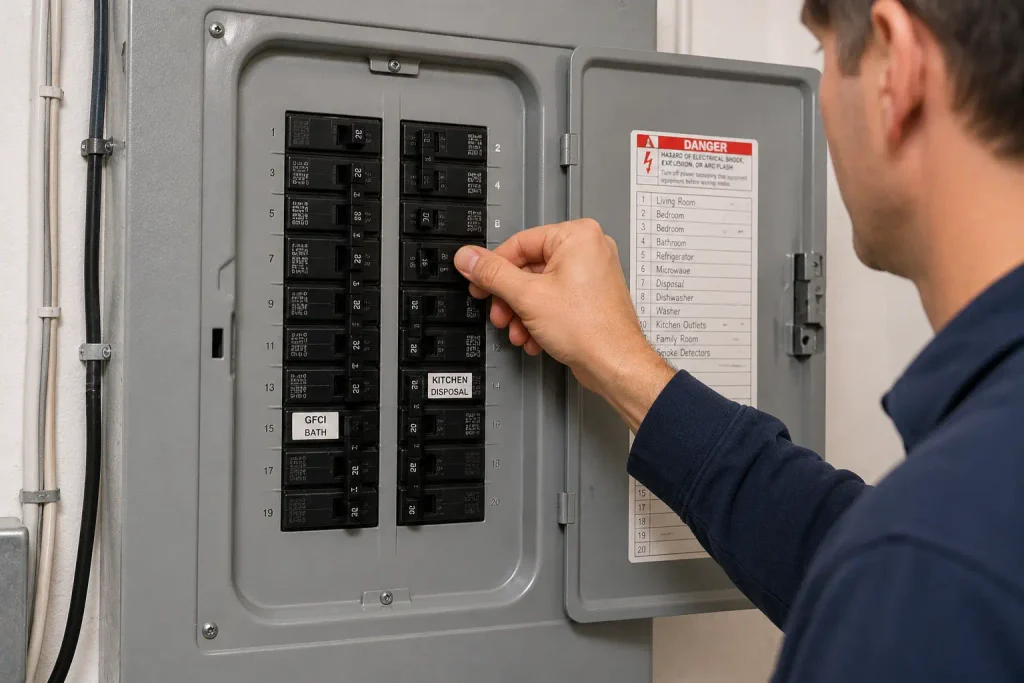
Test the disposal again.
A one-time trip can happen after an overload, but a breaker that repeatedly trips can indicate an electrical or appliance fault. In that situation, stop repeatedly resetting it and contact a qualified professional.
For additional electrical safety guidance, see the Electrical Safety Foundation International’s appliance safety recommendations.
Checking the breaker is an important step when figuring out how to fix a garbage disposal that has no power.
6. Let an Overheated Disposal Cool Down
Garbage disposals can shut themselves down when the motor becomes overloaded.
This can happen when too much food is added at once, the disposal becomes jammed, or the motor operates under excessive load.
Turn the unit off and give the motor time to cool.
Cooling time varies by model. Some manufacturer guidance recommends several minutes, while certain models may require longer, so checking the instructions for your specific disposal is best.
After it cools, check for an obstruction and use the reset button if your model has one.
Then restore power and test the unit.
7. Check for a Faulty Switch or Disposal
If you have tried the previous steps and the garbage disposal still does not work, the problem may be more serious.
Possible causes include a faulty wall switch, damaged wiring, an internal electrical failure, or a worn-out disposal motor.
At this point, avoid opening electrical components unless you are qualified to work on them.
A professional electrician, plumber, appliance technician, or manufacturer-authorized service provider can determine whether repair or replacement is the safer option.
Manufacturer troubleshooting guidance similarly recommends professional service when basic jam-clearing, reset, and power checks do not solve the problem.
What If the Garbage Disposal Is Humming but Not Spinning?
A humming sound is an important clue.
It usually means the motor is receiving power but the mechanism cannot rotate properly, often because something has jammed it.
Turn the disposal off immediately rather than allowing it to continue humming.
Disconnect the power, inspect for foreign objects with a flashlight, and use the correct disposal wrench to free the mechanism if your model supports this method.
Once the jam is cleared, reset the overload protector if necessary and test the disposal again.
How to Prevent Garbage Disposal Problems
Once you know how to fix a garbage disposal, a few simple habits can help reduce the chance of the same problem returning.
Avoid forcing large amounts of food waste into the disposal at once. Keep non-food objects out, and follow the manufacturer’s instructions about what your specific model can process.
When grinding food waste, follow the water-use instructions provided for your unit. For example, InSinkErator recommends cold water during grinding and warns against pouring grease, oil, or fat into the disposer.
Good everyday habits can reduce jams, overloads, and unnecessary strain on the motor.
If your sink is still draining slowly after the disposal is working properly, follow our guide on how to unclog a kitchen sink for additional troubleshooting steps.
When Should You Call a Professional?
Basic troubleshooting is appropriate for simple problems, but some situations should be handled professionally.
Call a qualified technician if the breaker repeatedly trips, you notice a burning smell or signs of electrical damage, the disposal leaks from the unit itself, the motor continues humming after the jam has been cleared, or the disposal remains completely dead after the basic power and reset checks.
You should also get professional help whenever troubleshooting requires opening electrical components or performing work beyond the manufacturer’s normal user-maintenance instructions.
Frequently Asked Questions
Why did my garbage disposal suddenly stop working?
Common causes include an overload, jam, tripped reset button, disconnected power supply, or tripped circuit breaker. Start with the simple power and reset checks before investigating a possible jam.
Where is the garbage disposal reset button?
On many models, the reset or overload-protection button is located on the bottom or lower portion of the disposal. The exact location varies by manufacturer and model.
Why does my garbage disposal hum but not spin?
A humming disposal often indicates that the motor is receiving power but the grinding mechanism is jammed. Turn the unit off rather than repeatedly trying to run it, then follow your manufacturer’s jam-clearing procedure.
Can I put my hand inside a garbage disposal if the power is off?
No. Keep your hands and fingers out of the disposal. Use appropriate long-handled tongs or pliers to retrieve visible objects after disconnecting the power.
Should I repair or replace an old garbage disposal?
It depends on the problem and the unit’s condition. A simple jam or overload can often be corrected, while repeated electrical problems, serious leaks, motor failure, or frequent breakdowns may make replacement more practical. A professional can diagnose the unit if basic troubleshooting does not solve the problem.
Final Thoughts
Learning how to fix a garbage disposal can save time when the problem is something simple like a tripped reset button, power interruption, overload, or minor jam. Knowing how to fix a garbage disposal can make common kitchen problems much easier to handle.
Start with the easiest checks and work through the troubleshooting steps one at a time. Most importantly, disconnect power before clearing an obstruction and never place your hand inside the disposal.
If the disposal still refuses to work after these seven fixes, professional diagnosis is safer than repeatedly trying to restart or dismantle the unit.