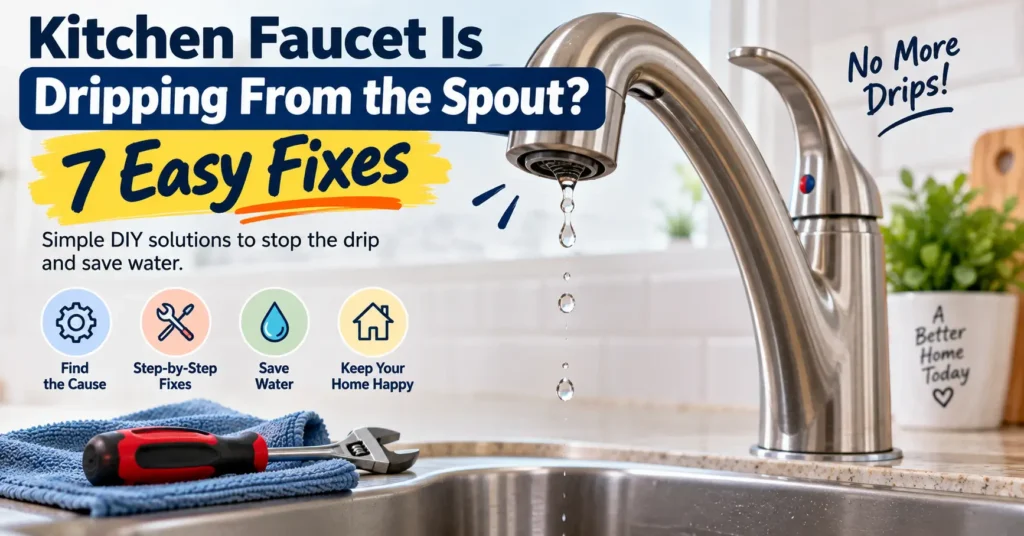
A leaking kitchen faucet may seem like a minor problem, but that constant drip can get very annoying and can waste water over time. Good news! Most faucet drips can be repaired with a few tools, some replacement parts.
If your kitchen faucet is dripping from the spout, the cause could be a worn cartridge, damaged O-ring, loose handle, dirty aerator, or another worn internal component.
Before replacing the entire faucet, try these 7 easy fixes to find and solve the problem.
Safety tip: Turn off the water supply to the faucet before taking apart any plumbing parts. If you see a broken water line or a leak under the sink, turn off the water and consider calling a licensed plumber.
Why Is My Kitchen Faucet Dripping From the Spout?
If you turn the handle of a kitchen tap off, it should stop water running. If water continues to drip from the spout, one of the parts inside may not be sealing properly.
The U.S. EPA WaterSense program also provides guidance on identifying and fixing common household leaks, including dripping faucets.
Common causes include:
- Worn faucet cartridge
- Damaged O-rings
- Loose faucet handle
- Mineral buildup
- Dirty aerator
- Worn valve components
- Damaged seals
- High water pressure
The repair depends on the type of faucet and the component causing the leak.
7 Easy Fixes If Your Kitchen Faucet Is Dripping From the Spout
1. Turn Off the Water Supply
Shut off the water supply valves under the sink before checking the faucet.
Look under the kitchen sink for two little shut-off valves. Most faucets have separate hot and cold water supplies.
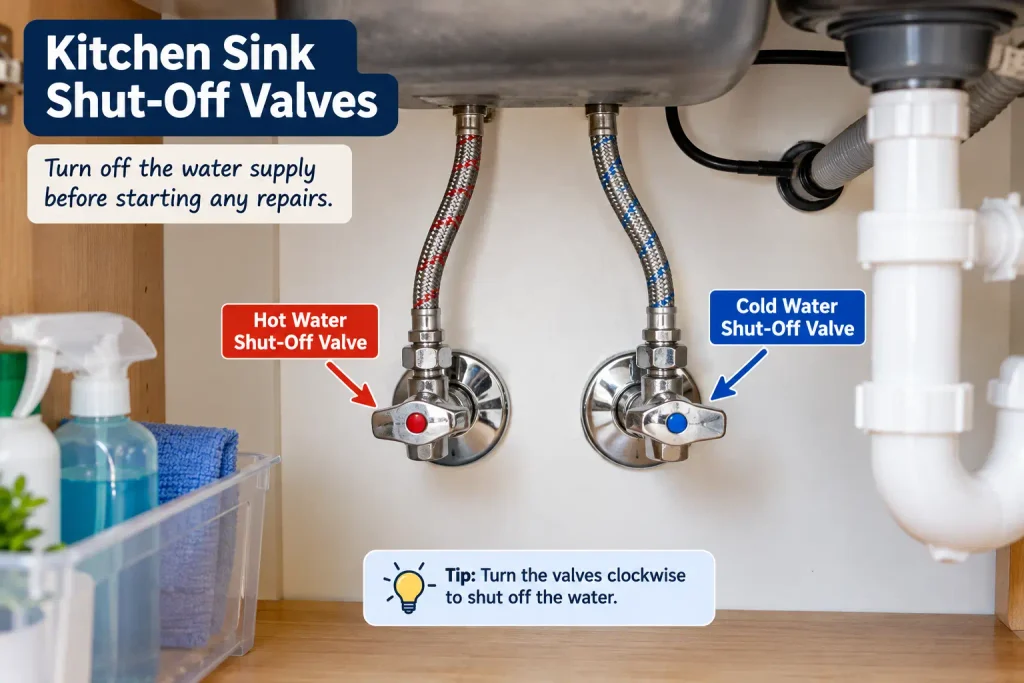
Turn the valves to the right to stop the water.
Turn them off, then open the tap a few seconds to relieve pressure from the water lines.
Why this matters
If you are working on a faucet with the water on , when you unscrew something , water will squirt out .
Place a small towel or container under the connections to catch any remaining water.
2. Clean the Faucet Aerator
The aerator is the small screen at the end of the faucet spout. It controls the flow of water and makes a steady stream.
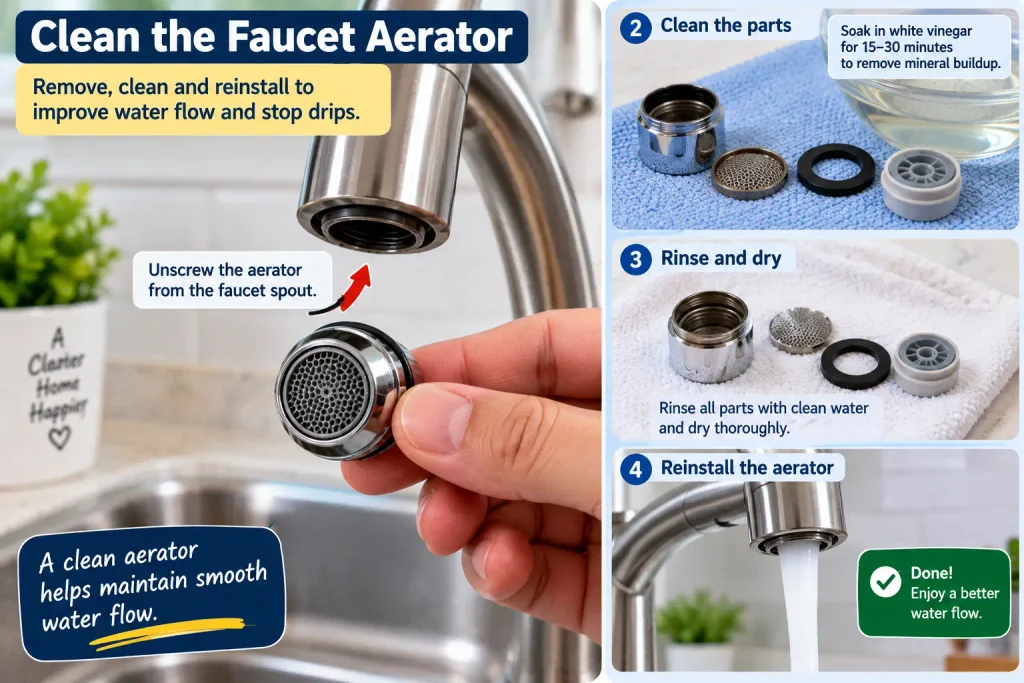
Mineral deposits may form within the aerator, particularly in regions with hard water.
A dirty aerator isn’t always the direct cause of a drip, but cleaning it can increase water flow and help you determine whether mineral buildup is part of the problem.
How to clean the aerator:
- Unscrew the aerator from the faucet spout.
- Separate the small screen and components carefully.
- Rinse away loose debris.
- Soak mineral-covered parts in white vinegar if appropriate for the material.
- Rinse thoroughly.
- Reassemble the aerator.
- Screw it back onto the faucet.
Don’t force a stuck aerator because you could damage the faucet finish or threads.
3. Check the Faucet Handle
Sometimes a loose or poorly positioned handle can interfere with the internal valve of the faucet from closing completely.
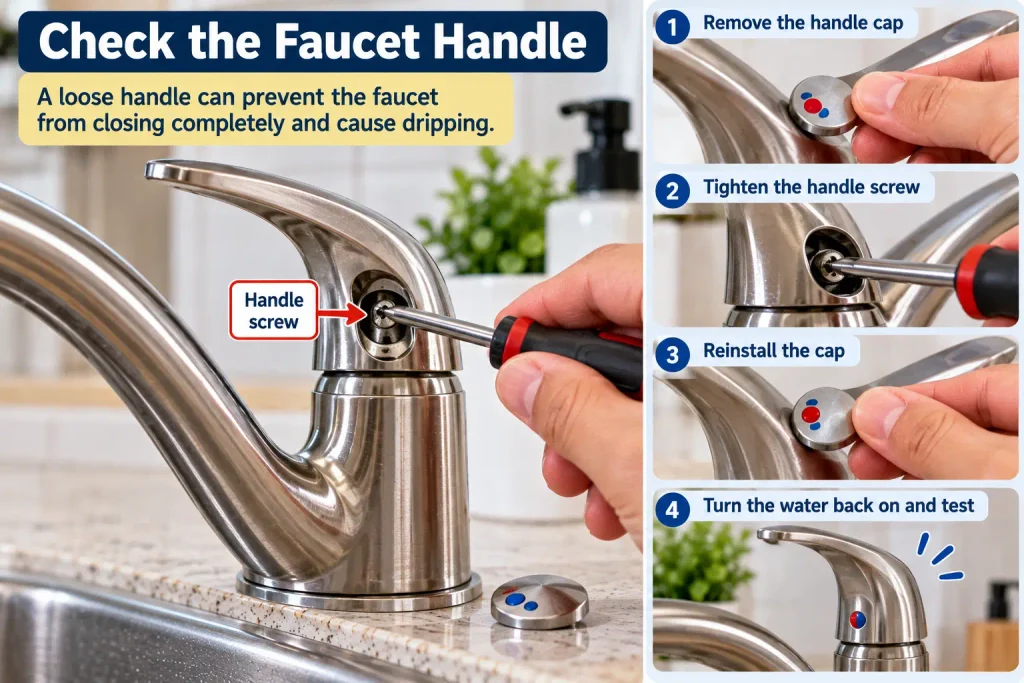
Check the handle to see if it moves more than it normally should.
If the handle is loose you may be able to tighten its retaining screw.
Try this:
- Turn off the water supply.
- Locate the handle screw or decorative cap.
- Remove the cap if necessary.
- Tighten the handle screw carefully.
- Reinstall the cap.
- Turn the water supply back on.
- Test the faucet.
Don’t overtighten the screw. Too much force can damage the handle or internal components.
4. Replace the Faucet Cartridge
A worn cartridge is one of the usual suspects when a single-handle kitchen faucet keeps dripping from the spout.
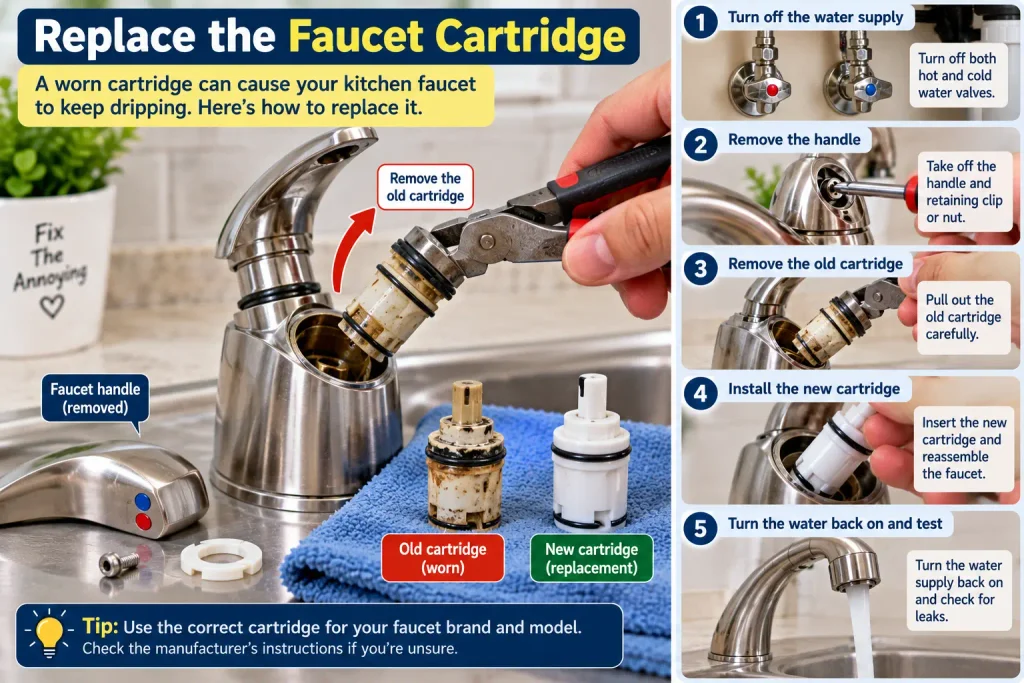
Inside, many of today’s faucets use a cartridge to control the flow of hot and cold water. Over time, its seals can get worn out or damaged.
Signs the cartridge may be the problem:
- The faucet continues dripping when fully closed.
- The handle feels rough or difficult to move.
- The faucet has become harder to control.
- Water continues to flow after adjusting the handle.
Basic replacement process:
- Turn off the water supply.
- Remove the faucet handle.
- Remove the retaining clip or nut.
- Pull out the old cartridge.
- Install the correct replacement cartridge.
- Reassemble the faucet.
- Turn the water supply back on.
- Check for leaks.
Important: The cartridge design is very different between one brand of faucet and another, and one model of faucet and another. Be sure to read the manufacturer’s instructions before you buy a replacement.t.
5. Replace Worn O-Rings
O-rings are tiny rubber gaskets that are used inside many faucets to stop water from leaking around moving or connected parts.
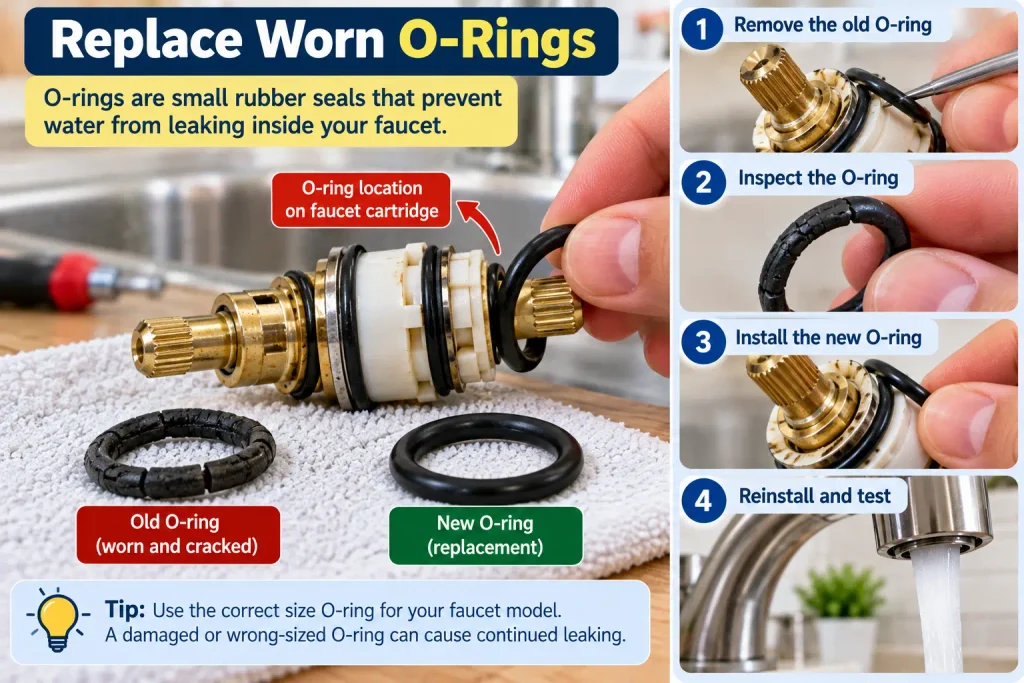
Over time, these rubber rings can become:
- Cracked
- Flattened
- Brittle
- Stretched
- Damaged
A damaged O-ring can allow water to escape even if the faucet looks like it is off.
If your faucet has replaceable O-rings, you may be able to fix the problem by simply replacing the O-rings instead of the entire faucet.
If you are installing a new O-ring, make sure you get the right size and type for the faucet.
6. Check the Valve Seat
Some types of faucets use a valve seat that works with other internal parts to control the flow of water.
Mineral deposits or corrosion can keep the parts from making a good seal.
If you have already checked the cartridge, handle and O-rings and the faucet is still dripping, the valve seat or another internal component may need to be checked.
Depending on the design of the faucet, this repair can be more complicated.
If you’re not comfortable taking the faucet apart any more, a professional might be the safer bet.
7. Replace Damaged Faucet Parts
Sometimes the best solution is simply to replace the damaged part, rather than trying to repair it.
Depending on your faucet, replacement parts may include:
- Cartridge
- O-rings
- Washers
- Valve components
- Aerator
- Handle
- Seals
Before ordering a replacement part, find the faucet’s brand and model number.
Using the wrong cartridge or seal can cause the faucet to leak or be damaged.
If parts are no longer available it may be better to replace the whole faucet.
How to Tell What Is Causing the Drip
There isn’t the same reason for every dripping faucet. Some observations can help to narrow down the problem.
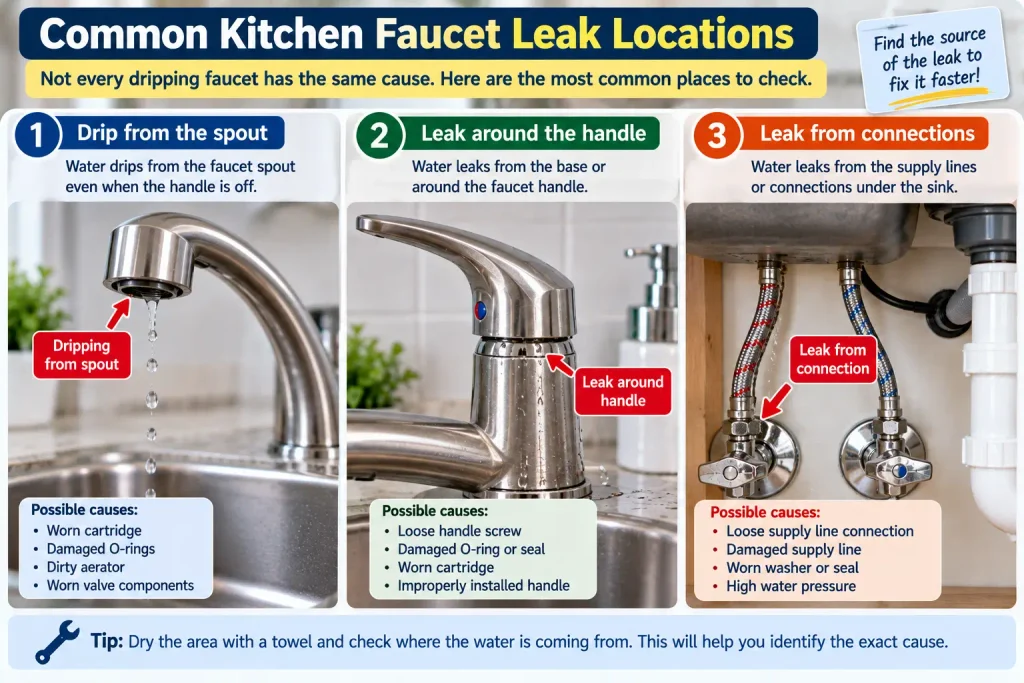
Drip continues when the handle is completely off
A worn cartridge, valve, washer, or seal may be responsible.
Handle feels loose
The handle or its retaining screw may need adjustment.
Handle feels stiff
Mineral deposits or a worn cartridge could be affecting the movement.
Water leaks around the handle
A damaged O-ring or internal seal may be responsible.
Water leaks from the hose or connections underneath the sink
The problem may be with a supply connection rather than the faucet spout.
It is important to make this distinction because a leaky supply connection will not be fixed by replacing the cartridge.
When Should You Call a Plumber?
There are lots of little faucet problems you can fix on your own. Professional help may be appropriate, however, if:
- The faucet body is cracked.
- A water supply line is damaged.
- You cannot shut off the water supply.
- The leak is coming from inside the wall or cabinet.
- A replacement part does not solve the problem.
- The faucet has severe corrosion.
- Water is causing damage to the cabinet.
- You are uncomfortable disassembling plumbing components.
If there is a heavy water leak under the sink, turn off the main water supply of house if necessary and fix the problem as soon as possible.
How to Prevent a Dripping Kitchen Faucet
Regular maintenance can help extend the life of your faucet.
Clean the aerator regularly
Mineral buildup can reduce water flow and affect faucet performance.
Don’t force the handle
If the handle is hard to move, do not force it. Might have to check the cartridge inside.
Fix leaks early
A small drip can become a larger plumbing problem if ignored.
Use the correct replacement parts
Always check the brand and model of your faucet before buying cartridges, seals or other parts.
Keep the area under the sink dry
Check the supply lines and connections from time to time for moisture. Catching a leak early can save your cabinets and floors from damage.
For additional home leak-prevention and maintenance tips, see the EPA WaterSense home maintenance guide.
For another common home plumbing problem, check out our guide: Toilet Won’t Stop Running? 8 Easy Fixes to Try.
Frequently Asked Questions
Why is my kitchen faucet dripping from the spout?
If your kitchen faucet is dripping from the spout even when the handle is off, a worn cartridge, damaged seal, O-ring, valve component, or other internal part may be preventing the faucet from closing properly.
How do I stop a kitchen faucet from dripping?
First turn off the water supply and inspect the handle, aerator, cartridge, O-rings and other internal parts. The way you fix a leak depends on what faucet it is and what’s causing the leak.
Do I need to replace the whole faucet?
Not always. Many leaky faucets can be repaired by replacing a cartridge, O-ring, seal or other single part. Though a badly damaged or corroded faucet is better replaced.
Can I fix a dripping faucet myself?
If you’re comfortable with basic plumbing parts, many common faucet repairs are do-it-yourself projects. Before taking the faucet apart, turn off the water supply.
Why does my faucet drip after I turn it off?
A small amount of water may remain in the spout right after use. But if the faucet drips for a long time, there may be an internal part that isn’t sealing properly.
How do I know which cartridge my faucet needs?
If possible, check the brand and model number of the faucet and use the manufacturer’s parts data. Not all models of faucets have the same cartridge design.
Final Takeaway
If your kitchen faucet is dripping from the spout, you may not need to replace the entire faucet.
Begin by turning off the water supply and troubleshooting the simplest problems. Wipe the aerator clean, inspect the handle, and then inspect parts such as the cartridge and O-rings.
If you continue to have a dripping faucet after replacing the appropriate worn part or you discover a damaged water line or serious corrosion, consider getting the help of a licensed plumber.
By catching a small drip early, you can prevent a minor plumbing nuisance from becoming a bigger problem.