
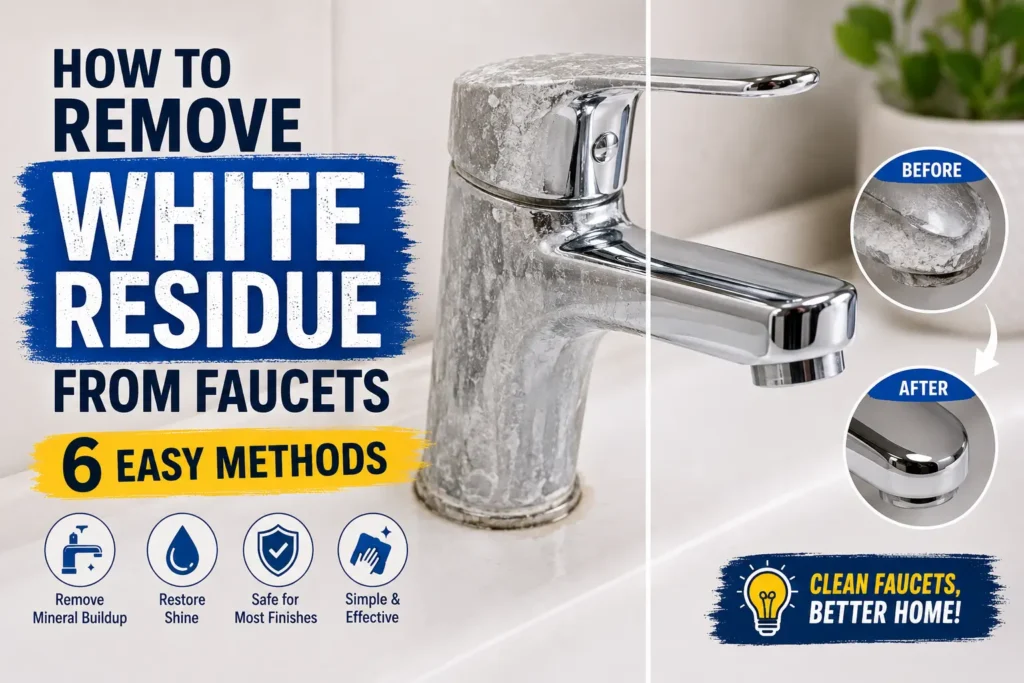
White, chalky residue around a faucet can make an otherwise clean sink look dirty. You may notice it around the base, handles, spout, aerator, or anywhere water regularly dries.
In many homes, this residue is caused by minerals left behind when hard water evaporates. Soap residue and cleaning products can sometimes contribute to the buildup as well.
If you’re wondering how to remove white residue from faucets, the safest approach is to start gently. Faucet finishes vary, and an aggressive cleaner or abrasive scrubber can cause more damage than the mineral deposits themselves.
Below are six practical methods, beginning with the mildest option.
Why Is There White Residue on My Faucet?
White residue usually develops when water droplets remain on the faucet and evaporate.
Understanding what causes the buildup makes it much easier to learn how to remove white residue from faucets without damaging the finish.
The water disappears, but dissolved minerals can remain behind. Over time, repeated wetting and drying may create visible spots, a chalky film, or crusty deposits.
Delta specifically notes that allowing water to evaporate on faucet surfaces can lead to mineral buildup and recommends drying the surface to help prevent it.
Common causes include:
- Hard water minerals
- Calcium and magnesium deposits
- Water spots
- Soap residue
- Cleaner residue
- Mineral buildup around the aerator
If the residue repeatedly returns shortly after cleaning, hard water is a likely contributor.
Before You Start: Check Your Faucet Finish
This step is important.
Not every faucet has the same finish. Your faucet might be:
- Chrome
- Stainless steel
- Brushed nickel
- Matte black
- Bronze
- Brass
- A specialty or coated finish
A cleaning method that works well on one faucet may not be recommended for another.
If possible, identify the faucet manufacturer and model and check its official care instructions before using vinegar, commercial mineral removers, or other cleaners.
For unfamiliar surfaces, KOHLER recommends testing cleaning solutions on an inconspicuous area first and using a soft cloth or sponge rather than abrasive materials.
Also protect nearby countertops and sinks, especially natural stone or other acid-sensitive materials.
1. Start With Warm Water and a Soft Cloth
For light white residue, start with the simplest method.
If you’re learning how to remove white residue from faucets, warm water and a soft cloth are a safe place to begin before trying stronger cleaning methods.
Dampen a clean microfiber or other soft cloth with warm water.
Gently wipe:
- The faucet body
- Around the handles
- The base
- The spout
- Areas where water spots are visible
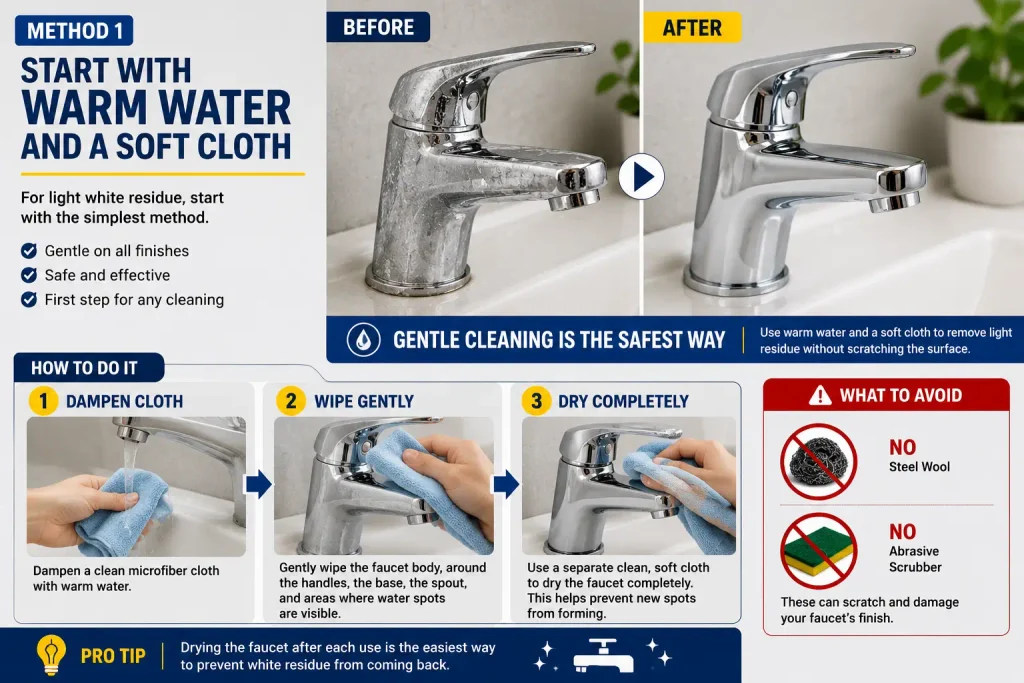
Avoid aggressive scrubbing.
After wiping, use a separate clean, soft cloth to dry the faucet completely.
This may be enough when you’re dealing with fresh water spots rather than heavy mineral buildup.
Delta recommends warm water and a soft damp cloth for water spots and advises using non-abrasive cleaning materials.
Why Drying Matters
If you clean the faucet and leave it wet, water can evaporate again and leave more minerals behind.
So don’t treat drying as an optional finishing touch—it is part of the cleaning process.
2. Use Mild Dish Soap for Greasy or Soapy Residue
Not every white mark is purely mineral buildup.
Soap, toothpaste, skin-care products, and everyday grime can collect around bathroom faucets, while kitchen faucets may develop residue from soap and food preparation.
Add a small amount of mild dish soap to warm water.
Dampen a soft cloth with the solution and gently clean the faucet.
Pay attention to tight areas around:
- Handle bases
- Faucet base
- Spout connections
- Seams
Then rinse the surface appropriately with clean water and dry it thoroughly with a soft cloth.
If the residue disappears with mild soap and water, you may not need an acidic or specialized cleaner.
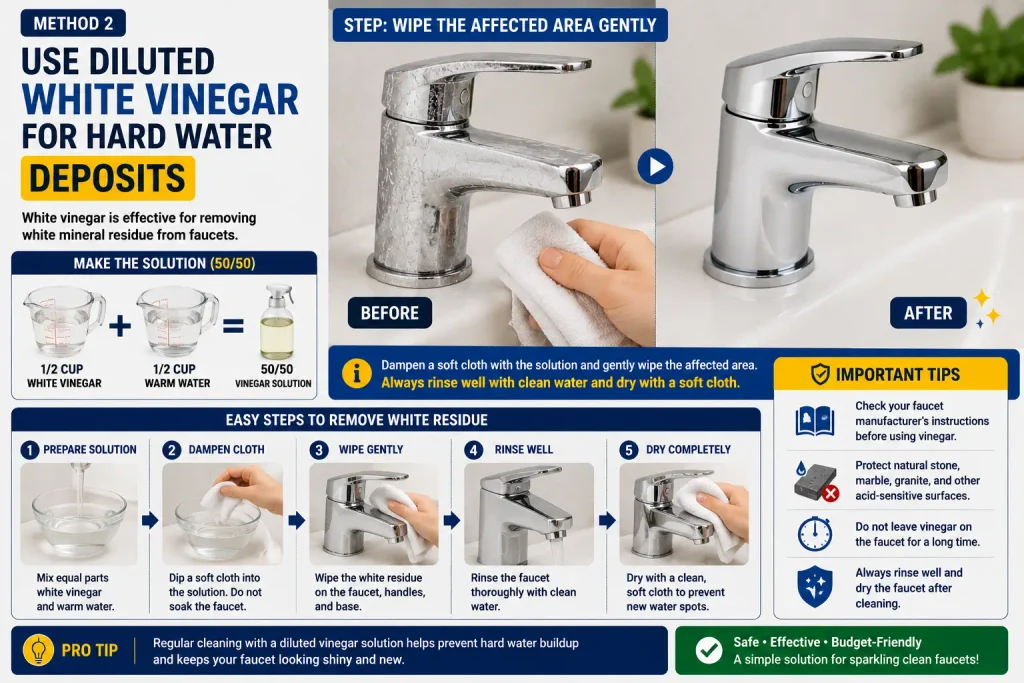
3. Try Diluted White Vinegar for Hard Water Deposits
If ordinary cleaning doesn’t remove the white mineral film, diluted white vinegar may be an option if your faucet manufacturer says it is safe for the finish.
For example, Delta recommends a 50/50 solution of white vinegar and water for hard-water stains on its faucet finishes, followed by thorough rinsing. KOHLER also provides a 50/50 vinegar-and-warm-water method for mineral buildup in specific faucet guidance.
Mix equal parts:
White vinegar + water
Dampen a soft cloth with the solution and gently wipe the affected area.
For more concentrated buildup, manufacturer-specific instructions may permit briefly placing a vinegar-dampened cloth around the affected area. Follow the instructions for your particular faucet rather than leaving acid on the finish for an arbitrary length of time.
Afterward:
- Rinse thoroughly with clean water.
- Remove all vinegar residue.
- Dry the faucet with a clean, soft cloth.
Important
Don’t assume vinegar is safe for every faucet finish or every nearby surface.
Vinegar can also affect acid-sensitive materials such as some natural stone. Protect the sink, countertop, backsplash, and surrounding materials from drips or overspray.
4. Clean Mineral Buildup Around the Faucet Aerator
White crust around the end of the spout may indicate mineral buildup around the aerator.
The aerator is the small component at the faucet outlet that helps shape and regulate the water stream.
Heavy mineral buildup can sometimes affect water flow as well as appearance.
If your faucet has a removable aerator, consult the manufacturer’s instructions before taking it apart. Some aerators require a special key or removal procedure.
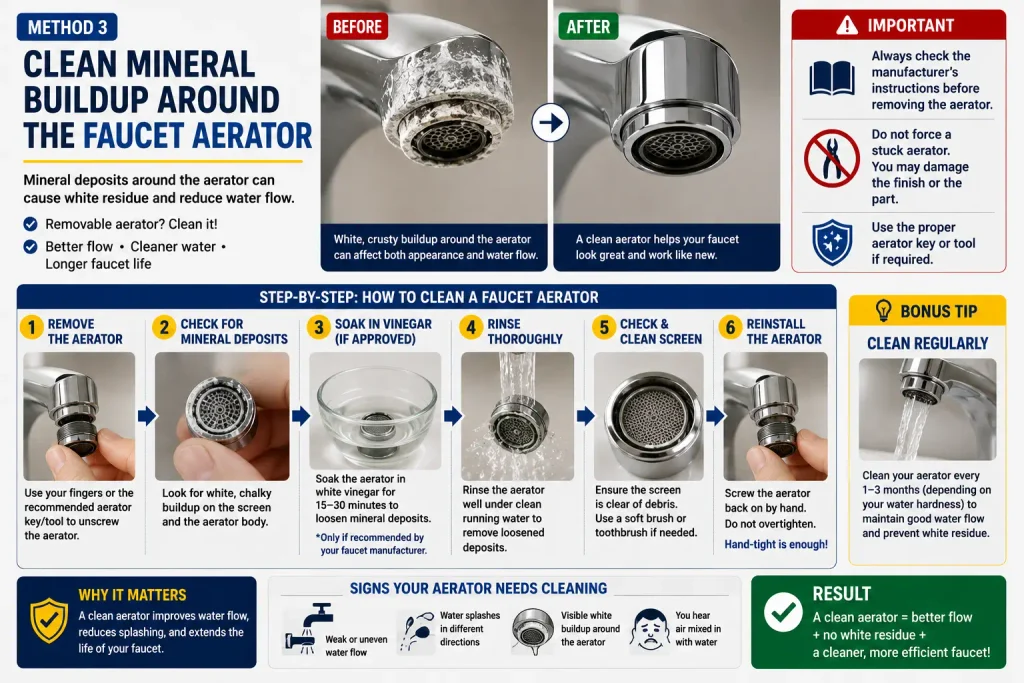
Once removed, clean it according to the manufacturer’s recommendations.
Delta, for example, recommends soaking removable aerators in vinegar and then flushing them with water for mineral-deposit removal.
Before reinstalling:
- Rinse away loosened deposits
- Check that screens/components remain correctly positioned
- Reinstall according to the manufacturer’s instructions
Don’t force an aerator that doesn’t loosen easily. You could scratch the finish or damage the component.
5. Use a Manufacturer-Approved Faucet Cleaner for Stubborn Buildup
If mild cleaning and a manufacturer-approved vinegar method don’t solve the problem, consider a cleaner specifically approved for your faucet’s finish.
This is safer than choosing a random heavy-duty bathroom or lime remover.
Before using any product:
- Read the entire label
- Check compatibility with your faucet finish
- Test an inconspicuous area if appropriate
- Protect nearby surfaces
- Follow ventilation instructions
- Rinse as directed
- Dry the faucet afterward
KOHLER’s general care guidance recommends rinsing surfaces completely after cleaner application and avoiding abrasive cleaning materials.
More chemical strength does not automatically mean better cleaning.
In fact, Delta warns against several harsh or abrasive cleaners, harsh polishes, bleach-based products, and certain strong acids because they can damage faucet finishes.
6. Prevent White Residue From Building Up Again
Once the faucet is clean, prevention is usually easier than repeatedly removing thick mineral deposits.
The simplest habit is to dry the faucet after it gets wet.
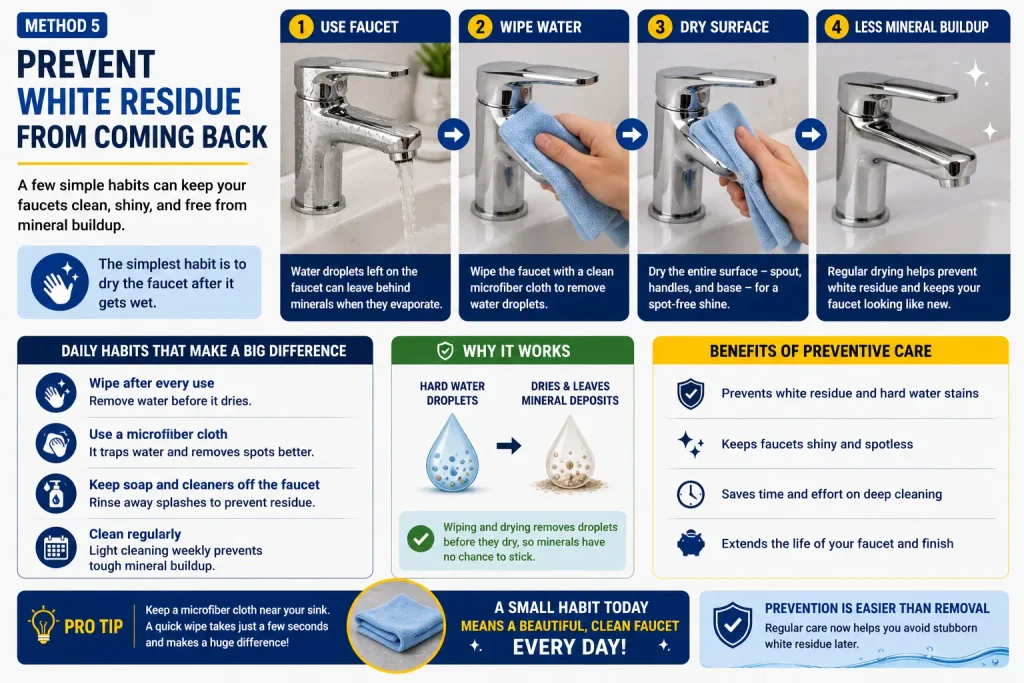
Keep a clean microfiber cloth nearby and quickly wipe away water from:
- The faucet body
- Handle bases
- Spout
- Faucet base
This prevents much of the water from evaporating directly on the finish.
Both manufacturer guidance and basic mineral-deposit behavior support this approach: reducing water left to evaporate reduces opportunities for visible deposits to remain behind. Delta specifically recommends blotting faucet surfaces dry.
Regular light cleaning can also prevent residue from becoming thick enough to require stronger treatment.
If your faucet continues dripping and leaving water around the fixture, our guide on how to fix a leaky faucet can help you troubleshoot the problem.
How to Remove Thick White Crust From a Faucet
A thick, chalky crust usually indicates mineral buildup that has accumulated over time.
When deciding how to remove white residue from faucets with heavier buildup, use gentle methods first rather than scraping the deposits away.
Don’t attack it with a knife, metal scraper, steel wool, or aggressive scouring pad.
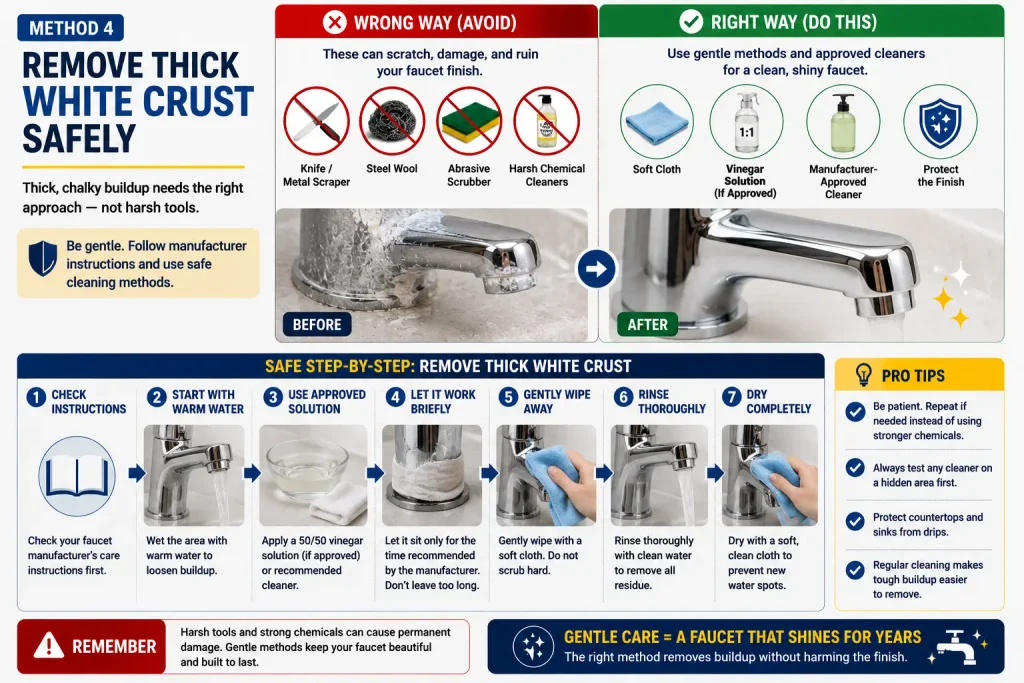
Instead:
- Check the manufacturer’s care instructions.
- Start with warm water and a soft cloth.
- If approved for the finish, try the manufacturer’s recommended diluted-vinegar method.
- Allow only the contact time recommended for the product or finish.
- Gently wipe away loosened buildup.
- Rinse thoroughly.
- Dry completely.
Several gentle treatments may be safer than one aggressive cleaning session.
If the deposit doesn’t respond, don’t keep increasing the strength of the cleaner without confirming that the faucet finish can tolerate it.
What Should You Avoid When Cleaning Faucet Mineral Deposits?
This is just as important as choosing the right cleaner.
Steel Wool
Steel wool can scratch or permanently alter many faucet finishes.
Abrasive Scouring Pads
Aggressive pads may dull or scratch the surface.
Metal Scrapers or Knives
Scraping mineral deposits with a sharp object can damage the finish.
Random Strong Acid Cleaners
Products intended for toilets, masonry, rust removal, or other heavy-duty applications may not be suitable for faucets.
Bleach-Based Cleaners
Don’t assume bleach is safe for faucet finishes. Follow the manufacturer’s care instructions.
Mixing Cleaning Products
Never mix cleaning chemicals unless the product instructions explicitly say the combination is safe.
In particular, never mix bleach with vinegar or ammonia, because hazardous gases can be produced.
Is White Residue on a Faucet Mold?
Usually, chalky white buildup around faucets is more consistent with mineral deposits or dried product residue than mold.
Mineral deposits often appear:
- White or off-white
- Chalky
- Crusty
- Around areas frequently exposed to water
However, appearance alone isn’t always enough to identify an unknown substance.
If you see unusual discoloration, persistent growth, moisture damage, or material that doesn’t behave like mineral residue, investigate the source rather than assuming it is hard water.
Why Does White Residue Keep Coming Back?
If the faucet looks clean but white spots return repeatedly, the issue may be your water rather than your cleaning technique.
Knowing why the deposits return is an important part of understanding how to remove white residue from faucets and keep them cleaner for longer.
Hard water contains dissolved minerals. Every time droplets dry on the faucet, some mineral material may remain behind.
This means you can remove the visible residue without changing the underlying reason it forms.
Regular drying and light cleaning can reduce visible buildup.
If mineral deposits are widespread throughout the home—on faucets, shower doors, fixtures, and appliances—you may want to learn more about your local water hardness and appropriate water-treatment options.
If you’re dealing with similar mineral buildup on other surfaces, see our guide on how to remove hard water stains for more practical cleaning methods.
Can White Residue Damage a Faucet?
Mineral buildup can become increasingly difficult to remove if it is allowed to accumulate.
The bigger risk during DIY cleaning, however, is sometimes damaging the finish while trying to remove the deposits.
Harsh chemicals, abrasive pads, metal tools, and excessive scrubbing can scratch, discolor, or dull certain finishes.
That’s why the safest approach to how to remove white residue from faucets is:
Start mild → check manufacturer guidance → escalate only when necessary.
How Often Should You Clean Faucet Buildup?
There is no universal schedule.
How quickly residue develops depends on:
- Water hardness
- Faucet usage
- How often water remains on the surface
- Faucet finish
- Soap and cleaning products
- Household cleaning habits
Instead of waiting for thick deposits, wipe away new spots when you notice them.
For homes with hard water, frequent drying may make a bigger difference than occasional aggressive deep cleaning.
Frequently Asked Questions
What is the white chalky stuff on my faucet?
It is commonly mineral residue left behind when hard water evaporates. Soap or cleaning-product residue can sometimes contribute to the appearance.
Does vinegar remove white buildup from faucets?
It can remove some hard-water mineral deposits, but compatibility depends on the faucet and surrounding surfaces. Some manufacturers, including Delta and KOHLER in specific guidance, recommend a 50/50 vinegar-and-water solution for mineral buildup. Always check the care instructions for your faucet first.
Can I leave vinegar on my faucet overnight?
Don’t do this unless the faucet manufacturer specifically instructs you to. Extended exposure may not be appropriate for every finish. Follow the manufacturer’s recommended concentration and contact time.
Can I use baking soda on faucets?
Be cautious. Baking soda can act as a mild abrasive, and faucet manufacturers may warn against abrasive cleaning. For that reason, a soft cloth and manufacturer-approved cleaning method are safer starting points.
How do I remove white buildup around the faucet base?
Start with warm water and a soft cloth. If the residue appears to be mineral buildup, check whether your faucet manufacturer approves diluted vinegar or another cleaner for that finish. Rinse and dry thoroughly afterward.
How do I keep calcium deposits off my faucet?
Reduce the amount of water that dries on the faucet. Wiping or blotting the fixture dry after use can help limit recurring mineral deposits.
Final Thoughts
Learning how to remove white residue from faucets doesn’t require starting with the strongest cleaner you can find.
Begin with warm water and a soft cloth. Use mild soap when you’re dealing with ordinary grime or product residue. For genuine hard-water buildup, follow the faucet manufacturer’s instructions; some manufacturers recommend diluted white vinegar for compatible finishes.
Pay special attention to the aerator if mineral buildup is affecting the end of the spout or water flow.
Most importantly, avoid abrasive tools and harsh chemicals that could turn a removable mineral deposit into permanent finish damage.
Once the faucet is clean, drying it regularly is one of the simplest ways to reduce recurring white residue.
For manufacturer-specific guidance, Delta Faucet’s official cleaning and maintenance guide explains how it recommends caring for its faucet finishes and removing hard-water stains.