

A kitchen faucet with weak water flow can make simple tasks like washing dishes, filling pots, and rinsing produce unnecessarily frustrating. Fortunately, kitchen faucet low water pressure is often caused by a small problem that you can troubleshoot without replacing the entire faucet.
A clogged aerator, partially closed shutoff valve, kinked supply line, or mineral buildup inside the faucet can all reduce water flow. If your kitchen faucet has low water pressure, checking these common trouble spots can often help you identify the cause quickly.In some cases, however, low pressure may be related to the home’s plumbing rather than the faucet itself.
Below are seven practical things to check, starting with the easiest fixes.
Safety note: Before disconnecting supply lines, cartridges, or other faucet components, shut off the appropriate water supply valves. If you discover a leak, damaged plumbing, severe corrosion, or a problem you aren’t comfortable repairing, contact a qualified plumber.
Why Is My Kitchen Faucet Water Pressure So Low?
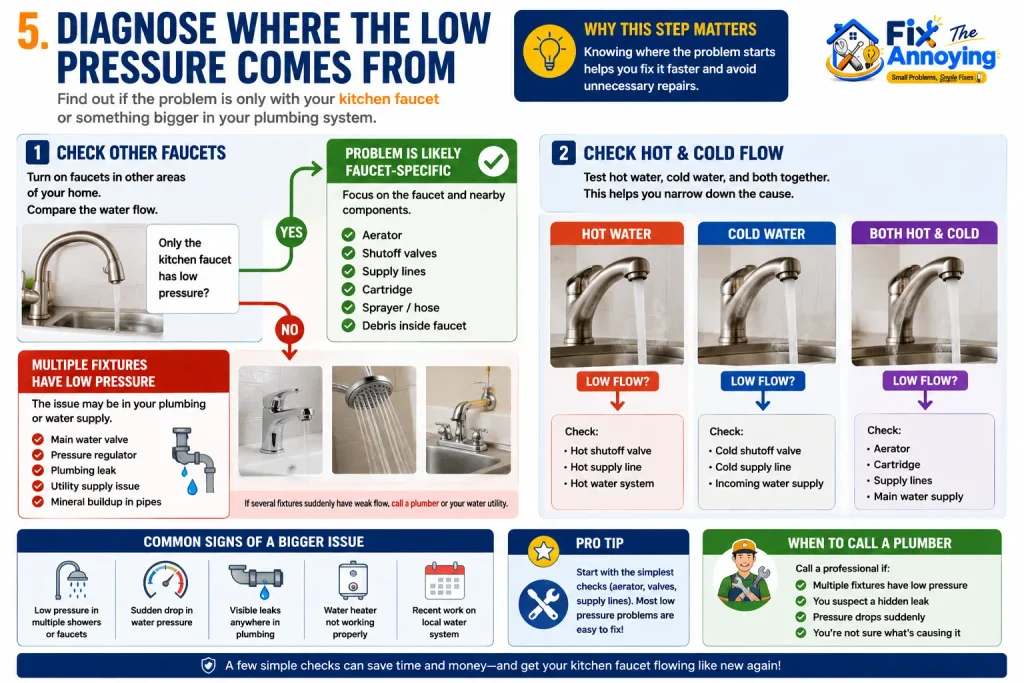
Before taking anything apart, determine whether the problem affects only the kitchen faucet or multiple fixtures in your home.
Turn on nearby faucets and showers and compare their water flow.
When your kitchen faucet has low water pressure but nearby fixtures work normally, the problem is usually localized to the faucet or its supply connections.
When your kitchen faucet has low water pressure but nearby fixtures work normally, the problem is usually localized to the faucet or its supply connections.
If only the kitchen faucet has low water pressure, the problem is more likely to be somewhere around the faucet itself. Common causes include:
- A clogged faucet aerator
- Partially closed shutoff valves
- Kinked or obstructed supply lines
- Mineral deposits
- A clogged or worn faucet cartridge
- Problems with a pull-down or pull-out sprayer
- Debris inside the faucet
If several fixtures suddenly have weak flow, the issue may involve the home’s main water supply, pressure regulator, plumbing, or utility supply.
1. Check Whether Both Hot and Cold Water Have Low Pressure
Start by determining whether the problem affects both sides of the faucet.
Run the cold water only and observe the flow. Then run the hot water only.
If both have similarly weak flow, the aerator or another component shared by both water paths may be restricted.
If only the hot or cold side has poor flow, focus on that side’s shutoff valve, supply line, or related plumbing.
This simple test can prevent you from unnecessarily disassembling the entire faucet.
2. Clean the Faucet Aerator
A clogged aerator is one of the first things worth checking when a kitchen faucet has low water pressure.
The aerator is usually located at the tip of the faucet spout. Its small screens can collect sediment, rust particles, and mineral deposits over time.
Unscrew the aerator carefully. Depending on the faucet design, you may be able to remove it by hand, while recessed aerators may require the manufacturer’s aerator key.
Once removed:
- Separate the aerator components carefully.
- Rinse away loose debris.
- Use a soft brush to clean the screen.
- Remove mineral buildup using a cleaning method suitable for your faucet and aerator materials.
- Rinse everything thoroughly.
- Reassemble the parts in their original order.
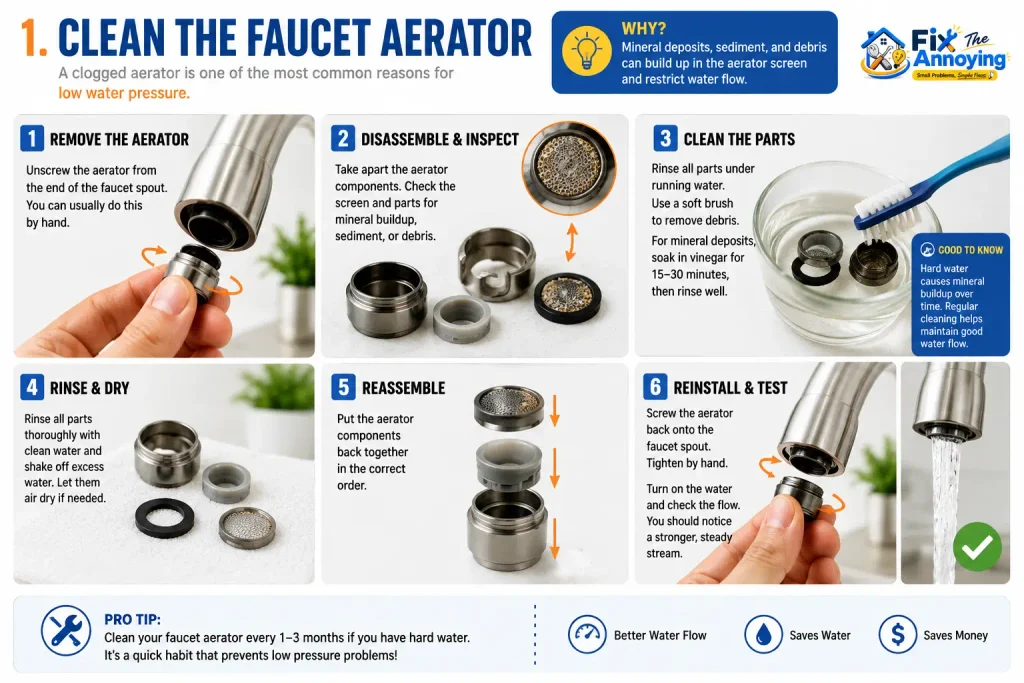
Before reinstalling the aerator, briefly test the faucet according to the manufacturer’s instructions if appropriate for your faucet design.
If the flow is much stronger without the aerator, you’ve likely found the restriction.
For additional troubleshooting steps, see Moen’s official guide to diagnosing low water flow in kitchen faucets.
Avoid forcing a stuck aerator with tools that could scratch or damage the faucet finish.
3. Make Sure the Shutoff Valves Are Fully Open
Under the kitchen sink, you’ll typically find shutoff valves supplying hot and cold water to the faucet.
A valve that isn’t completely open can restrict water flow.
If your kitchen faucet has low water pressure, make sure both the hot and cold shutoff valves are fully open before checking more complicated components.
Look underneath the sink and identify both valves. Check whether they are fully open according to their design.
If someone recently worked under the sink, a valve may have been partially closed and never fully reopened.
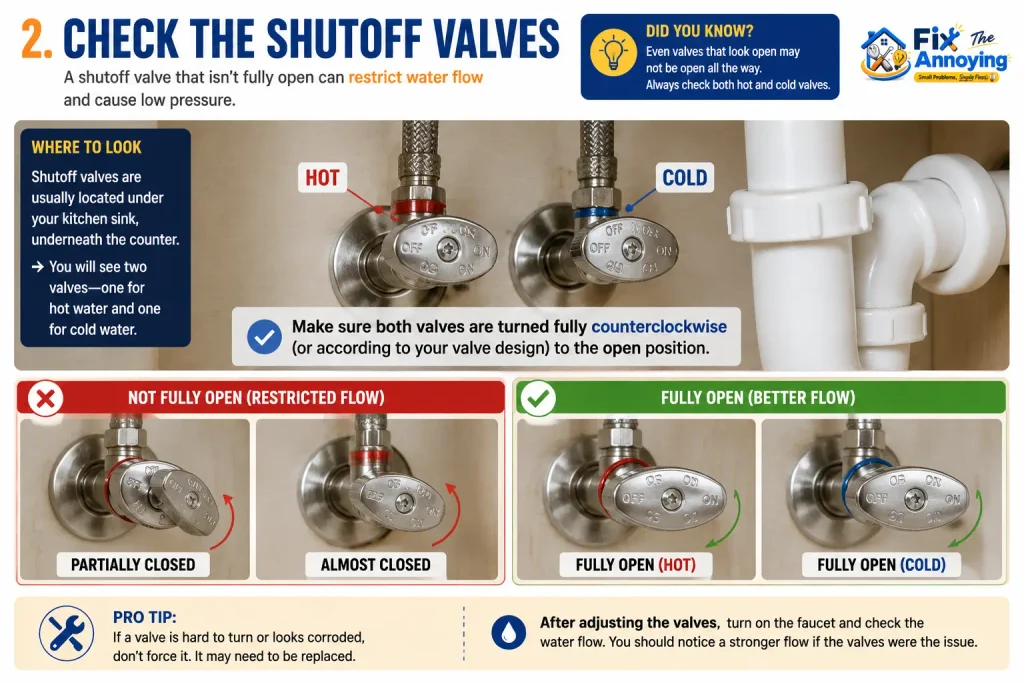
Don’t force an old, corroded, or stuck valve. Aging shutoff valves can leak when disturbed, and a plumber may be the safer option if the valve appears damaged.
After checking the valves, test the faucet again.
4. Inspect the Faucet Supply Lines
Next, inspect the flexible water supply lines running between the shutoff valves and the faucet.
Look for:
- Sharp bends
- Kinks
- Twisting
- Crushing
- Visible damage
- Signs of leakage
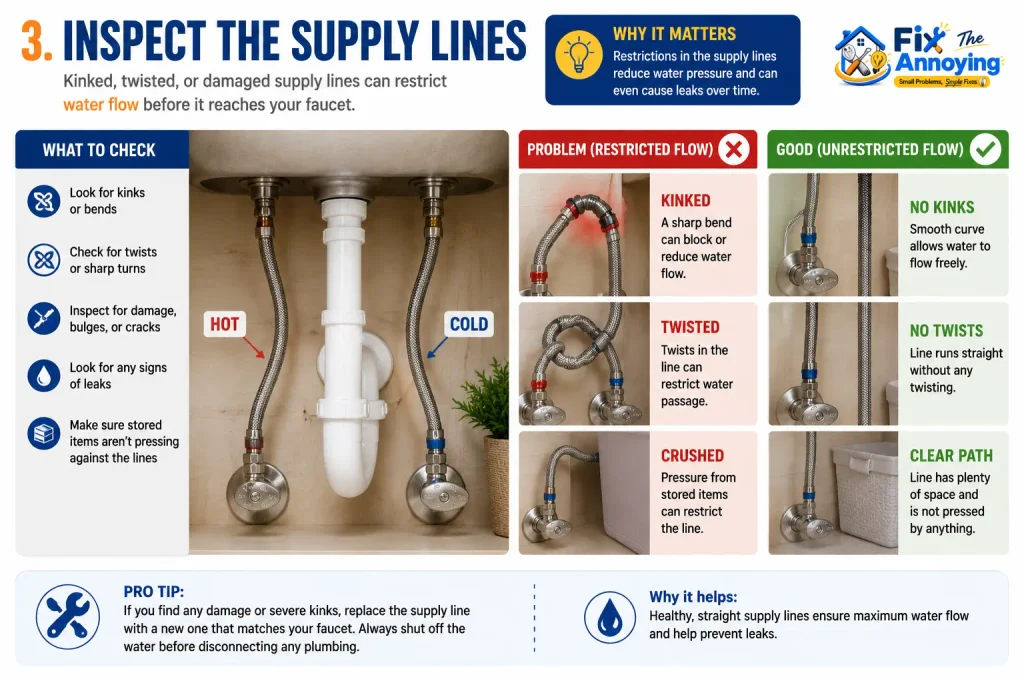
A kinked supply hose can restrict water before it ever reaches the faucet.
When a kitchen faucet has low water pressure, a bent or obstructed supply line can sometimes be the hidden cause.
Make sure items stored underneath the sink aren’t pressing against the lines.
If a line appears damaged or severely kinked, replacement may be necessary. Shut off the water before disconnecting any plumbing connection, and use a compatible replacement line.
5. Check the Faucet Cartridge for Buildup or Debris
If the aerator, valves, and supply lines appear normal, the faucet cartridge may be restricting flow.
If your kitchen faucet has low water pressure even after those basic checks, buildup or debris inside the cartridge may be worth investigating.
The cartridge is an internal component that helps control water flow and temperature. Sediment or mineral deposits can sometimes interfere with its operation.
Cartridge removal varies considerably between faucet brands and models.
Before removing one:
- Shut off both water supply valves.
- Open the faucet to relieve remaining pressure.
- Cover or close the sink drain so small parts aren’t lost.
- Check the faucet manufacturer’s instructions for your specific model.
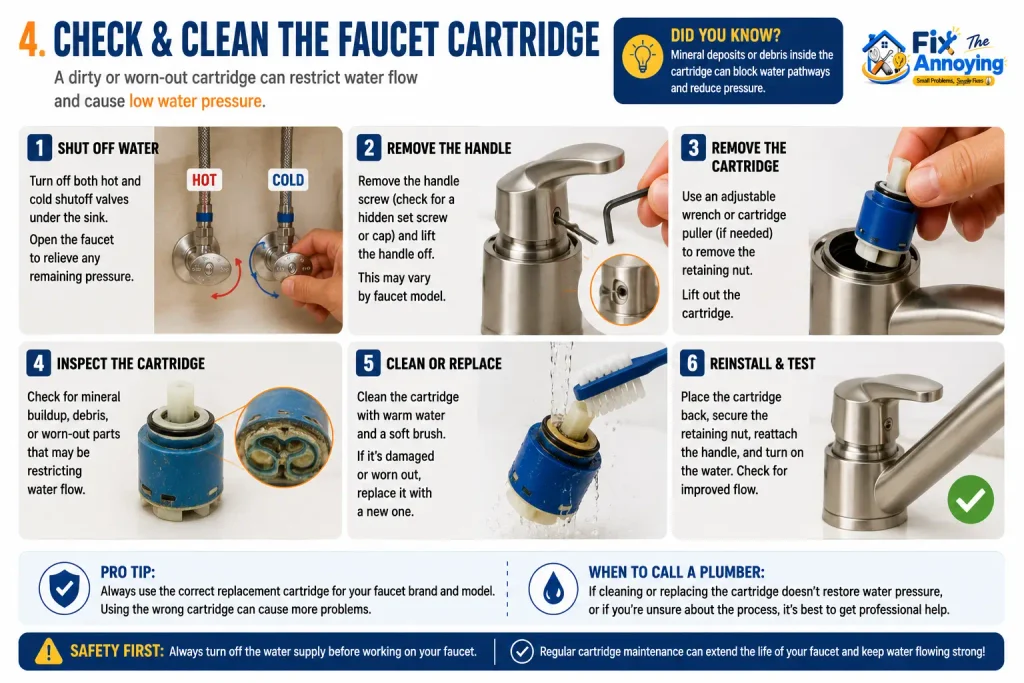
Depending on its condition and the manufacturer’s recommendations, the cartridge may need cleaning or replacement.
Don’t force internal faucet components. Damaging the cartridge housing can turn a relatively simple repair into a larger faucet replacement.
6. Check the Pull-Down or Pull-Out Sprayer
If your kitchen faucet has a pull-down or pull-out spray head, the restriction may be inside the sprayer rather than the main faucet body.
Check the spray head for mineral buildup or debris around its nozzles.
Some models also contain screens, flow restrictors, check valves, or other components that can become obstructed.
Inspect the hose as well. Make sure it moves freely underneath the sink and isn’t kinked, pinched, or tangled around plumbing or stored items.
If the faucet has normal flow in one spray mode but poor flow in another, the spray head itself becomes a stronger suspect.
Follow the manufacturer’s cleaning instructions because spray-head designs vary.
7. Check for a Broader Plumbing or Water-Supply Problem
If none of the faucet-specific fixes solve the problem, determine whether the issue extends beyond the kitchen.
Check water flow at several fixtures around your home.
If multiple faucets have suddenly developed low pressure, possible causes include:
- A partially closed main water valve
- Plumbing leaks
- A pressure-regulator problem
- Mineral buildup or corrosion in older plumbing
- Work being performed on the local water system
- Another restriction in the home’s water supply
At this point, repeatedly disassembling the kitchen faucet probably won’t solve the underlying problem.
If the pressure drop is significant, sudden, or affecting the entire property, contact your water utility when appropriate or have the plumbing system inspected by a qualified professional.
Kitchen Faucet Low Water Pressure After Replacing the Faucet
Sometimes low flow starts immediately after a new faucet is installed.
In that situation, check the installation before assuming the new faucet is defective.
Possible causes include a supply valve that wasn’t completely reopened, a kinked supply line, installation debris caught in the aerator, or an incorrectly connected component.
New plumbing work can occasionally loosen sediment that travels downstream and collects in a small screen or aerator.
Review the manufacturer’s installation instructions and verify each connection.
Kitchen Faucet Low Water Pressure After Turning the Water Back On
If the problem began after the home’s water supply was shut off and restored, debris may have entered the faucet.
Start with the aerator because its fine screen often catches particles before they travel farther.
If cleaning the aerator doesn’t restore normal flow, check the supply side and internal components according to the faucet manufacturer’s instructions.
What If Only the Hot Water Pressure Is Low?
When cold water flows normally but hot water is weak, the faucet aerator is less likely to be the only cause because both typically exit through the same outlet.
Check the hot-water shutoff valve and hot supply line first.
If other hot-water fixtures also have weak flow, the problem could extend beyond the kitchen faucet and may require inspection of the home’s hot-water system.
Avoid attempting repairs on a water heater or other pressurized equipment unless you’re qualified to do so.
What If Only the Cold Water Pressure Is Low?
The same troubleshooting logic applies to the cold side.
Check the cold-water shutoff valve and supply line for restrictions or kinks.
If cold water pressure is poor throughout the home rather than only at the kitchen faucet, investigate the broader water supply instead of dismantling the faucet repeatedly.
How to Prevent Low Water Flow in a Kitchen Faucet
A little routine maintenance can reduce the chances of another restriction.
Clean the faucet aerator periodically if your water contains significant mineral deposits. Keep the area beneath the sink organized so supply lines and pull-down hoses aren’t crushed or kinked.
If you notice progressively weaker flow, investigate it early rather than waiting until the faucet barely runs.
If the faucet flow is normal but water is backing up in the sink, the issue may be drainage-related instead. See our guide on how to unclog a kitchen sink for the appropriate troubleshooting steps.
Also repair plumbing leaks promptly. Low flow accompanied by unexpected moisture, water stains, or unexplained water usage deserves further investigation.
If you also notice dripping or leaking around the faucet, follow our guide on how to fix a leaky faucet for additional troubleshooting steps.
When Should You Call a Plumber?
DIY troubleshooting makes sense when the problem is limited to accessible faucet components and you can work safely.
If your kitchen faucet has low water pressure and none of the basic troubleshooting steps restore normal flow, professional diagnosis may be the safer next step
Consider professional help when:
- Several fixtures have low pressure.
- A shutoff valve is stuck, corroded, or leaking.
- Supply plumbing appears damaged.
- Water pressure suddenly drops throughout the home.
- You suspect a hidden leak.
- Faucet components cannot be safely removed.
- Cleaning the aerator and checking basic connections doesn’t help.
A plumber can measure actual water pressure and determine whether the restriction is in the faucet, fixture supply, or broader plumbing system.
Frequently Asked Questions
Why does my kitchen faucet suddenly have low water pressure?
A sudden reduction can be caused by debris in the aerator, a partially closed valve, a kinked supply line, faucet-component blockage, or a broader supply problem. Start by checking whether other fixtures are affected.
Can a clogged aerator cause low water pressure?
Yes. Sediment and mineral deposits in an aerator can restrict the amount of water leaving the faucet. Cleaning the aerator is therefore one of the simplest first troubleshooting steps.
Why is my kitchen faucet pressure low but other faucets are fine?
When other fixtures work normally, the problem is more likely localized to the kitchen faucet, its aerator, supply valves, supply lines, cartridge, or spray head. This is especially likely when the kitchen faucet has low water pressure while every other fixture continues to have normal flow.
Why is only my kitchen faucet’s hot water pressure low?
Check the hot-water shutoff valve and supply line first. If hot-water flow is weak at multiple fixtures, the issue may be elsewhere in the hot-water plumbing system.
Should I remove the flow restrictor to increase water pressure?
Not as a first troubleshooting step. Flow-control components may be part of the faucet’s intended design and may be required for efficiency or regulatory compliance. Diagnose clogs, supply restrictions, and faulty components instead of modifying the faucet to exceed its intended flow.
Final Thoughts
When a kitchen faucet has low water pressure, start with the simplest possibilities before replacing parts. Compare hot and cold flow, clean the aerator, verify the shutoff valves, and inspect the supply lines.
If those checks don’t solve the problem, investigate the cartridge and spray head according to the faucet manufacturer’s instructions.
Most importantly, determine whether the issue is limited to the kitchen faucet. When several fixtures have weak pressure, the faucet itself may not be the real problem.