
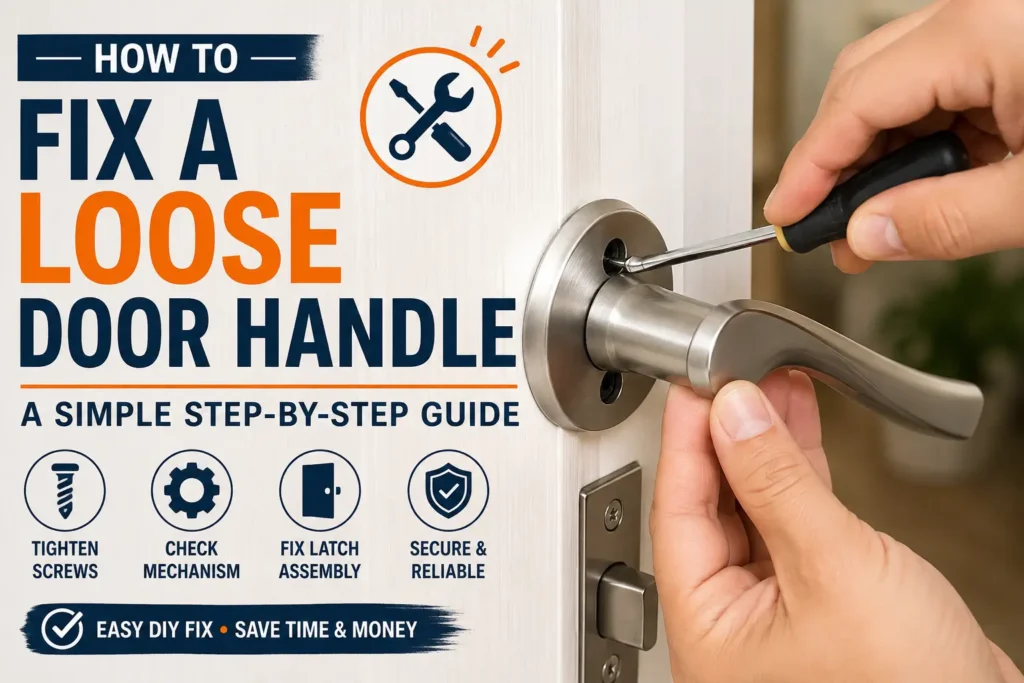
A loose door handle may seem like a small problem, but it can quickly become frustrating. The handle may wobble every time you open the door, the screws may keep coming loose, or the handle may eventually stop operating the latch properly.
Fortunately, many loose door handle problems are relatively simple to fix. In most cases, the issue is caused by loose mounting screws, hidden fasteners, worn hardware, or a problem with the spindle or latch mechanism.
If you’re wondering how to fix a loose door handle, this guide walks you through the most common causes and practical fixes step by step.
Quick safety note: If the handle is on an exterior door and the lock no longer works reliably, treat it as a security issue. Repair or replace the damaged hardware as soon as possible.
Why Does a Door Handle Become Loose?
Door handles are used repeatedly every day. Over time, the constant turning, pulling, and pushing can gradually loosen the hardware.
Common causes include:
- Loose mounting screws
- Hidden screws that have worked loose
- A worn or damaged spindle
- Stripped screw holes
- Loose mounting plates
- Worn internal components
- A loose latch assembly
- Improper installation
- Aging door hardware
Before replacing the entire handle, inspect it carefully. Often, a few minutes of tightening or adjustment can solve the problem.
Tools You May Need
The exact tools depend on the type of handle installed on your door, but you may need:
- Phillips-head screwdriver
- Flat-head screwdriver
- Allen key or hex key
- Small flashlight
- Replacement screws
- Wooden toothpicks or small wood splinters
- Wood glue
- Clean cloth
Avoid using excessive force when tightening screws. Overtightening can strip screw holes, damage the hardware, or make the handle difficult to operate.
Step 1: Identify What Part of the Door Handle Is Loose
Before reaching for a screwdriver, determine exactly where the movement is coming from.
Hold the handle and gently move it up, down, and from side to side.
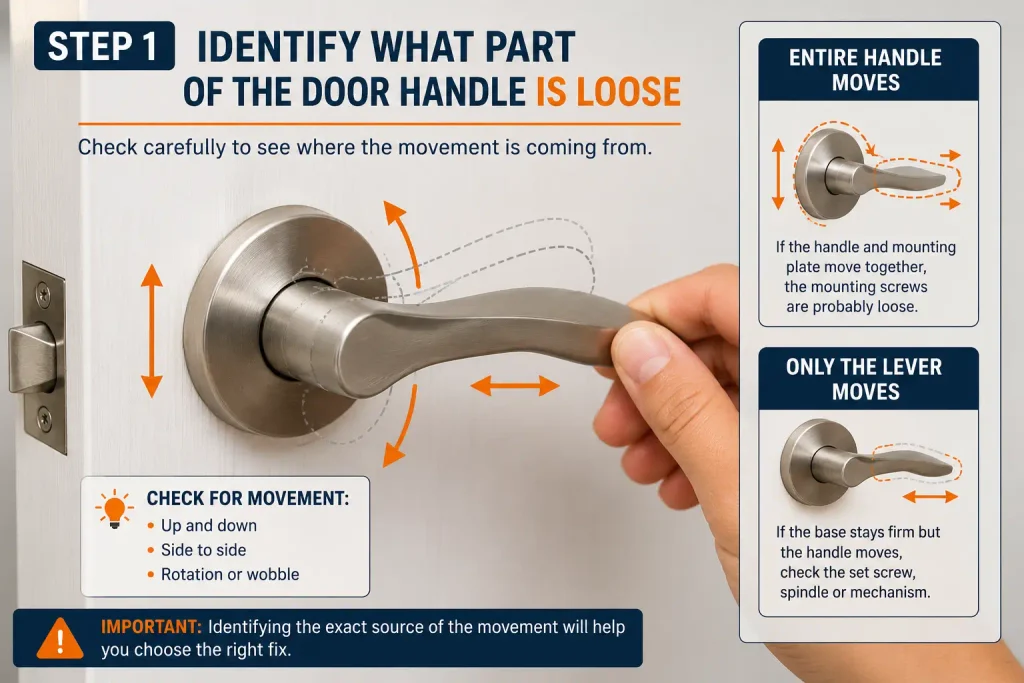
Watch the mounting plate or rosette—the plate sitting against the door.
There are several possibilities.
The entire handle assembly moves
If the handle and mounting plate move together, the mounting screws are probably loose.
Only the lever or knob moves
If the base stays firmly against the door but the handle itself wobbles, the problem may involve a set screw, spindle, or internal mechanism.
The handle turns but does not operate the latch correctly
This can indicate a problem with the spindle or latch mechanism rather than simply loose mounting screws.
Identifying the source of the movement first makes it much easier to choose the correct repair.
Step 2: Tighten the Visible Screws
Many door handles have two visible screws on the mounting plate.
Open the door so you can comfortably access both sides of the handle.
Using the correct screwdriver, gently tighten each screw.
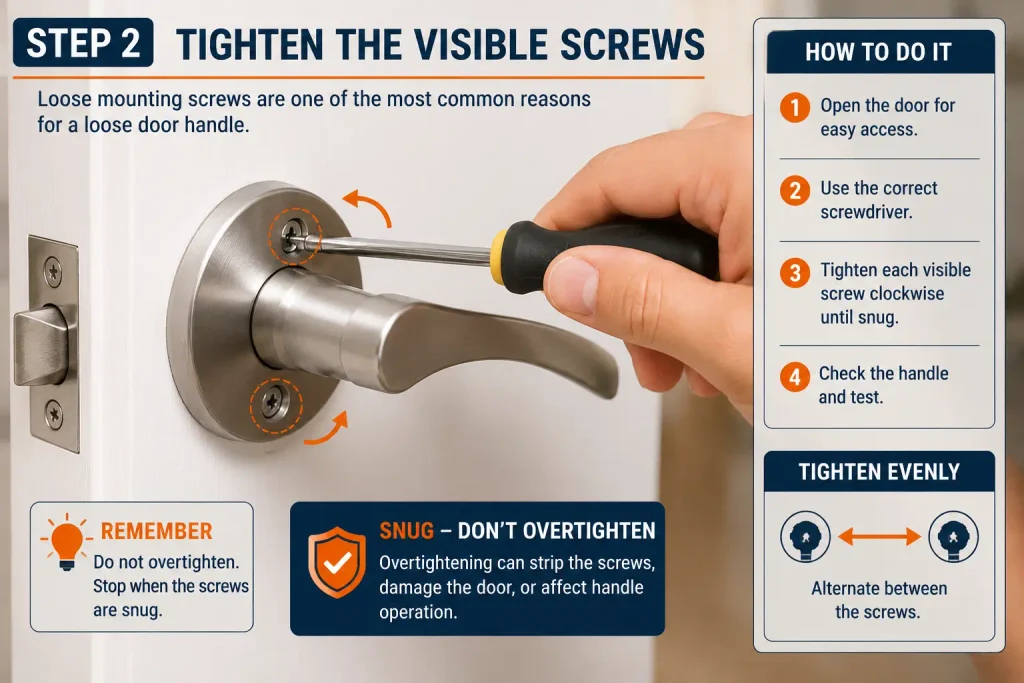
Alternate between the screws rather than tightening one completely before the other. This helps keep the handle assembly evenly positioned against the door.
Once the screws feel secure, test the handle.
Turn it several times and check whether the wobble has disappeared.
Don’t overtighten the screws
Stop when the screws are snug.
Excessive tightening can damage the screw heads, strip the holes, distort the mounting plate, or cause the handle mechanism to bind.
If the screws keep turning without becoming tight, you may have stripped screw holes. We’ll address that later in the guide.
Step 3: Tighten Hidden Screws on the Door Handle
Some modern door handles have no visible mounting screws.
For model-specific instructions, check the door hardware manufacturer’s installation and support guidance before removing or adjusting the handle mechanism.
Instead, the screws are concealed behind a decorative cover called a rosette or trim plate.
Look carefully around the edge of the plate.
You may find:
- A small notch
- A release slot
- A tiny set screw
- A removable decorative cover
Depending on the design, you may need a small flat-head screwdriver or Allen key.
If there is a removable cover, carefully release it according to the handle manufacturer’s instructions. Avoid forcing the trim because thin decorative plates can bend or scratch.
Once the cover is removed, the mounting screws should become visible.
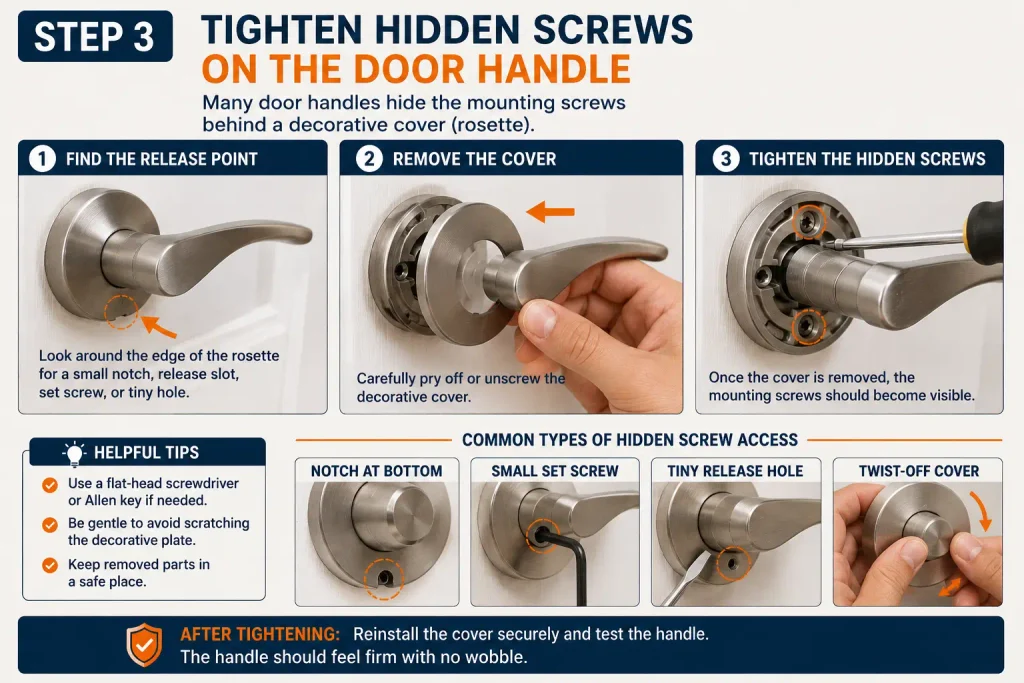
Tighten them evenly, reinstall the cover, and test the handle again.
Step 4: Check the Spindle and Handle Mechanism
If the mounting plate is tight but the handle still feels loose, inspect the spindle.
The spindle is the shaft that connects the handles and allows them to operate the latch when you turn the knob or push the lever.
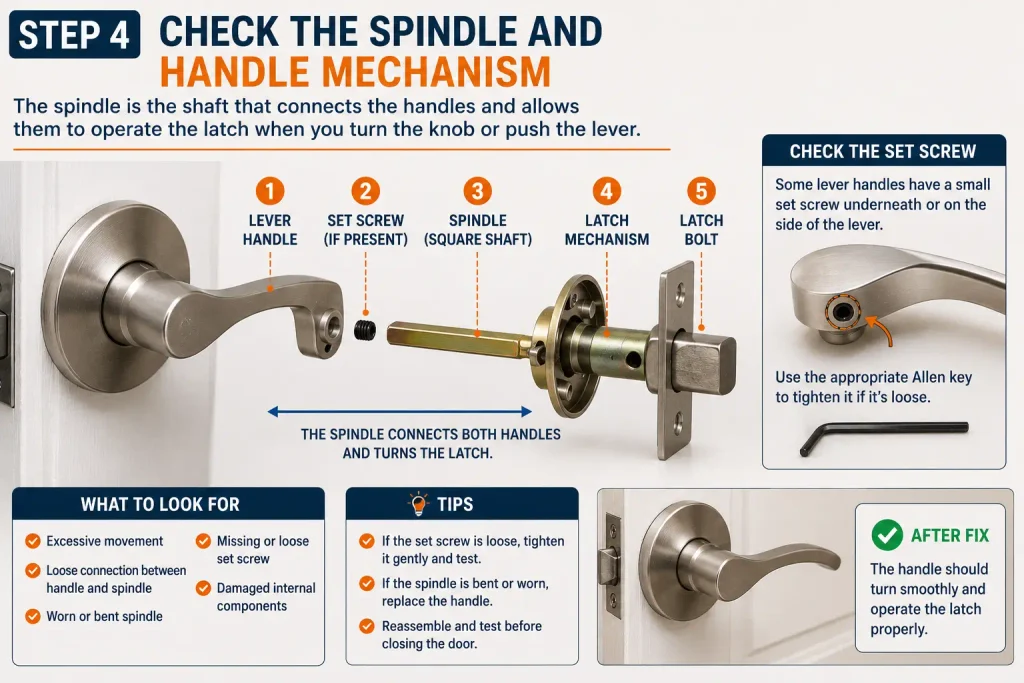
Depending on the handle design, you may need to remove one side of the handle to inspect it.
Look for:
- Excessive movement
- A loose connection between the handle and spindle
- Worn edges
- Bent components
- A missing or loose set screw
Some lever handles use a small set screw underneath or along the side of the lever to secure it to the spindle.
If you find one, use the appropriate Allen key or screwdriver to tighten it carefully.
Reassemble the handle and test it.
If the spindle or internal components are visibly damaged, replacing the damaged part—or the entire handle assembly—may be more reliable than repeatedly tightening it.
Step 5: Fix Loose or Stripped Screw Holes
Sometimes the screw is not the real problem.
If a screw spins continuously or becomes loose again shortly after tightening, the screw hole may be stripped.
This can happen when screws have been overtightened or removed and reinstalled repeatedly.
For screws that fasten directly into a wooden door, minor damage can sometimes be repaired.
Remove the loose screw.
For a small stripped hole in solid wood, one common repair is to insert a small amount of wood glue with one or more wooden toothpicks or suitable wood splinters into the damaged hole.
Allow the glue to cure according to its instructions.
Trim the excess wood flush with the surface, then carefully reinstall the screw.
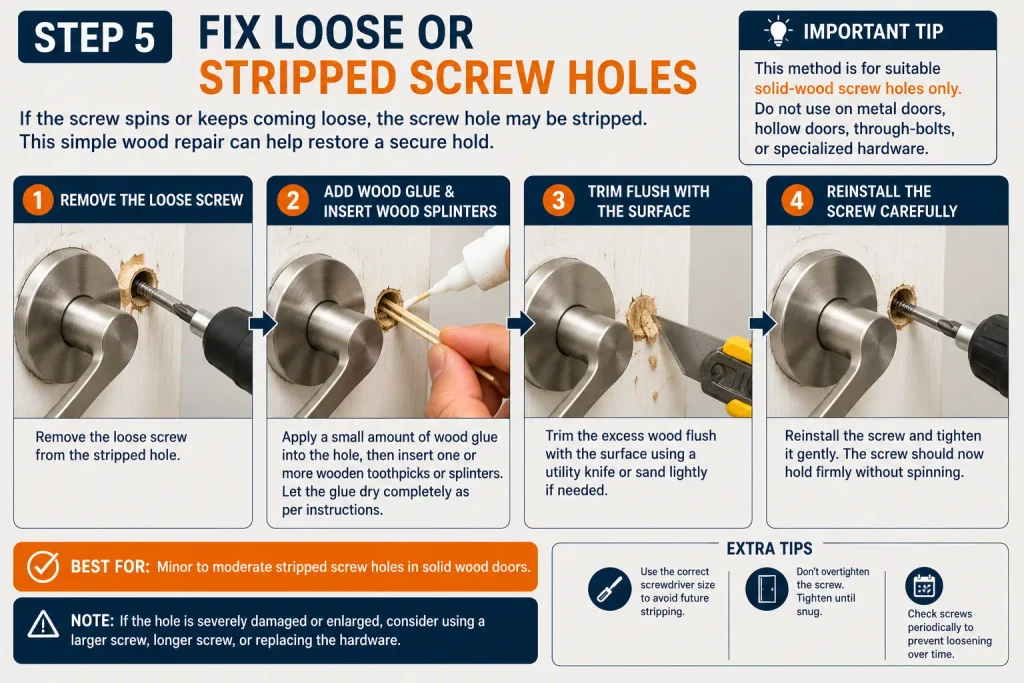
The added wood gives the screw fresh material to grip.
However, this technique is not appropriate for every door or every type of mounting screw. Do not use it blindly on through-bolts, metal doors, hollow doors, specialized hardware, or fire-rated door assemblies.
If the surrounding material is badly damaged, a more substantial repair or replacement hardware may be necessary.
Step 6: Check and Tighten the Latch Assembly
A loose handle can sometimes be accompanied by a loose latch.
Look at the edge of the door where the latch bolt extends.
You should see a faceplate secured by screws.
Check whether the faceplate moves when you operate the handle.
If the screws are loose, tighten them gently.
Then turn the handle and watch the latch.
The latch should retract smoothly and return when you release the handle.
If it sticks, moves only partially, or fails to return, the problem may be inside the latch mechanism.
Do not keep forcing a handle connected to a jammed latch. Excessive force can damage additional components.
Step 7: Reassemble and Test the Door Handle
After tightening or repairing the necessary components, reinstall any covers or handle parts you removed.
Before closing the door, test the handle while the door remains open.
Turn or press the handle several times.
Confirm that:
- The handle feels secure
- The mounting plate does not move
- The handle returns normally
- The latch retracts completely
- The latch extends again when released
- There is no unusual grinding or resistance
Next, gently close the door and test it normally.
The latch should engage with the strike plate without requiring excessive force.
If the door itself sticks, sags, or doesn’t close properly, the problem may involve door alignment rather than the handle.
What If the Door Handle Is Still Loose?
If you’ve tightened all accessible screws but the handle continues to wobble, something inside the assembly may be worn or damaged.
Possible causes include:
- Worn spindle
- Damaged set screw
- Cracked mounting plate
- Worn spring mechanism
- Damaged internal components
- Incorrectly sized replacement hardware
- Severely stripped mounting points
At this stage, repeatedly tightening the same screws probably won’t provide a lasting solution.
Remove the handle only if you’re comfortable doing so and inspect the components for visible damage.
For inexpensive or heavily worn hardware, replacing the complete handle assembly can sometimes be simpler and more reliable than trying to repair individual internal parts.
When Should You Replace the Door Handle?
Not every loose handle needs replacement.
If tightening the screws solves the problem and the mechanism works smoothly, replacement usually isn’t necessary.
Consider replacing the handle when:
- The handle remains loose after tightening
- Internal components are broken
- The spindle is badly worn
- The mounting plate is cracked
- Screws can no longer be secured properly
- The latch repeatedly fails
- The handle does not return to its normal position
- The lock is unreliable
- The hardware is heavily corroded or damaged
Replacement becomes particularly important when the problem affects an exterior door.
A loose bedroom or closet handle may be inconvenient, but faulty exterior door hardware can create a security problem.
How to Prevent a Door Handle From Becoming Loose Again
Once you know how to fix a loose door handle, a little preventive care can help stop the same problem from returning.
Check the screws occasionally
If you notice the first signs of movement, inspect the screws before the handle becomes extremely loose.
Don’t use the handle to pull a stuck door
If the door sticks in the frame, repeatedly pulling hard on the handle puts unnecessary stress on the mounting hardware.
Instead, determine why the door is sticking.
If your door also makes noise when opening or closing, follow our guide on how to fix a squeaky door for simple ways to solve the problem.
Fix door alignment problems
A door that requires excessive force to close can put additional pressure on the handle and latch.
Loose hinges, seasonal swelling, or alignment problems may need separate attention.
Avoid overtightening
Tighter isn’t always better.
Overtightening screws can damage the threads or the material they grip, eventually making the handle more difficult to secure.
Replace badly worn hardware
If a handle has significant internal wear, repeated adjustments may only provide temporary improvement.
Replacing worn components early can prevent the handle from failing completely.
Frequently Asked Questions
Why does my door handle keep coming loose?
Repeated use can gradually loosen mounting screws or set screws. Stripped screw holes, worn spindles, damaged internal parts, or door alignment problems can also cause the handle to become loose repeatedly.
Can I fix a loose door handle without removing it?
Yes, in many cases. If the handle has visible mounting screws, simply tightening them may solve the problem. Handles with hidden screws may require removing a decorative cover, while internal problems may require partial disassembly.
How do you tighten a door handle with no visible screws?
Check around the handle or decorative plate for a small notch, release slot, or set screw. Many handles conceal their mounting screws behind a removable trim plate. The exact removal method varies by manufacturer and model.
Why is my door handle loose even though the screws are tight?
The problem may be a loose set screw, worn spindle, damaged mounting plate, or worn internal mechanism. If the base is secure but the lever or knob still moves excessively, inspect these components.
Can a loose door handle affect the lock?
Yes. Depending on the design, worn or loose handle components can interfere with proper latch or lock operation. If an exterior door cannot be locked securely, repair or replace the hardware promptly.
Should I use threadlocker on loose door handle screws?
Only if the hardware manufacturer recommends it for that specific fastener. Some products can make later disassembly difficult or may not be appropriate for certain materials. Start by identifying why the screw is becoming loose rather than automatically applying an adhesive.
How tight should door handle screws be?
They should be snug enough to hold the assembly firmly against the door without movement. Avoid excessive force because overtightening can strip threads, damage the door, or interfere with smooth handle operation.
Final Thoughts
Learning how to fix a loose door handle can save you from replacing perfectly usable hardware.
Start with the simplest solution: identify where the movement is coming from and check the mounting screws. If that doesn’t solve the problem, inspect hidden fasteners, the spindle, screw holes, and latch assembly.
After every repair, test the handle thoroughly while the door is open before checking normal operation with the door closed.
If internal parts are badly worn or an exterior door no longer locks reliably, replacement is usually a better option than repeatedly trying to tighten failing hardware.
A properly secured door handle should feel firm, operate the latch smoothly, and allow the door to open and close without unnecessary force.