Soap scum is one of the most common cleaning problems in bathrooms. It can leave shower glass looking cloudy, make bathroom tiles appear dull, and create a sticky layer on bathtubs, shower walls, and faucets. Even when you clean your bathroom regularly, soap residue can gradually build up and become difficult to remove.
Soap scum usually develops when soap ingredients react with minerals in hard water. Body oils, shampoo, conditioner, and other bathroom residues can also contribute to the buildup. If it is not removed regularly, the residue can become more noticeable and require additional cleaning.
The good news is that you do not always need expensive cleaning products to deal with this problem. Mild dish soap, warm water, a soft sponge, and a suitable bathroom cleaner can help remove many types of soap scum.
However, choosing the correct cleaning method is important. A solution that works on ceramic tiles may damage marble, delicate finishes, or certain bathtub surfaces.
In this guide, you will learn how to remove soap scum from shower glass doors, bathroom tiles, bathtubs, shower walls, and faucets. You will also discover safe cleaning methods, common mistakes to avoid, and practical ways to prevent soap scum from returning.
What Is Soap Scum?
Soap scum is a residue that develops when traditional soap reacts with minerals found in hard water.
Hard water contains dissolved minerals, particularly calcium and magnesium. When these minerals interact with certain soap ingredients, they can form an insoluble deposit that sticks to bathroom surfaces.
According to the US Geological Survey (USGS), hard-water minerals can react with soap and contribute to the white or grey residue commonly found on bathroom surfaces.
Soap scum may appear as:
- A white or grey film on shower glass.
- A cloudy coating on bathroom tiles.
- A sticky layer inside bathtubs.
- Dull residue around faucets.
- Stubborn deposits on shower walls.
- A greasy-looking layer around bathroom fixtures.
Soap scum is not always made up of soap alone. Body oils, dead skin cells, shampoo, conditioner, and other residues can become trapped in the buildup.
Soap Scum vs Hard Water Stains vs Limescale
These bathroom problems can look similar, but they are not exactly the same.
| Type | Common appearance | Main cause |
|---|---|---|
| Soap scum | White, grey or cloudy film | Soap reacting with minerals |
| Hard water stains | White spots or cloudy marks | Minerals left after water evaporates |
| Limescale | Hard, crusty mineral deposits | Accumulated calcium and magnesium compounds |
| Ordinary dirt | Dust, grime or visible particles | Everyday use and contamination |
For additional information about mineral deposits and hard-water residue, read the American Cleaning Institute’s guide to hard water residue.
Hard water minerals can contribute to soap scum, so these deposits sometimes appear together. The correct cleaning method depends on what is actually on the surface.
The US Geological Survey explains how hard-water minerals interact with soap and contribute to soap scum formation. U.S. Geological Survey+1
Why Does Soap Scum Build Up in Bathrooms?
Soap scum develops gradually through repeated contact with soap, water, and bathroom surfaces.
Here are some common reasons.
1. Frequent Use of Bar Soap
Some traditional bar soaps contain ingredients that react with hard-water minerals. Repeated use can leave residue on shower walls, glass doors, and bathtubs.
2. Hard Water
Hard water contains calcium and magnesium. These minerals can react with soap and contribute to stubborn deposits.
3. Inadequate Rinsing
When soap and shampoo are not rinsed away completely, their residue can remain on bathroom surfaces.
4. Body Oils and Skin Residue
Natural body oils and skin residue can mix with soap deposits, making the buildup greasy and difficult to clean.
5. Infrequent Bathroom Cleaning
Small amounts of residue can accumulate over time. If bathroom surfaces are not cleaned regularly, the buildup may become more difficult to remove.
6. Poor Bathroom Ventilation
Poor ventilation allows moisture to remain in the bathroom for longer. Although moisture does not directly create soap scum, it can contribute to other bathroom maintenance problems.
7. Shampoo and Conditioner Buildup
Hair-care products can leave a film on shower walls, tiles, and bathtubs, contributing to the overall residue.
Signs Your Bathroom Has Soap Scum
You may have soap scum buildup if you notice:
- Cloudy shower glass that does not become clear after ordinary rinsing.
- White or grey film on bathroom tiles.
- Sticky or slippery bathtub surfaces.
- Dull-looking faucets and fixtures.
- Residue around shower handles.
- Buildup near bathroom corners and drains.
- A layer that becomes more noticeable after water dries.
Cleaning tip: If the deposit feels hard and crusty rather than slippery or greasy, it may contain significant mineral buildup. A soap-scum cleaner may not be enough.
What You Need to Remove Soap Scum
Before starting, identify the material you are cleaning and check its manufacturer’s care instructions.
For additional surface-care guidance, check Kohler’s bathroom product care and cleaning recommendations before choosing a cleaning product for your bathroom fixtures.
Here are some useful cleaning supplies.
| Cleaning supply | Purpose | Important limitation |
|---|---|---|
| Mild dish soap | Helps loosen oily soap residue | Check compatibility with the surface |
| Warm water | Helps rinse and loosen residue | Avoid excessive heat on sensitive materials |
| White vinegar | Helps dissolve certain mineral deposits | Avoid on marble and other acid-sensitive stone |
| Microfiber cloth | Gentle wiping and drying | Use a clean cloth |
| Soft sponge | Removes loosened residue | Avoid abrasive surfaces |
| Non-abrasive brush | Cleans suitable grout and corners | Check brush compatibility |
| Spray bottle | Applies suitable cleaning solutions | Label containers clearly |
| Rubber gloves | Protects hands | Follow cleaner safety instructions |
| Bathroom cleaner | Treats compatible bathroom buildup | Follow the product label |
Important: Never assume that a household ingredient is safe for every bathroom surface. Test a suitable cleaner in an inconspicuous area when the manufacturer recommends it.
How to Remove Soap Scum with Household Cleaning Methods
There are several ways to clean soap scum, depending on how much buildup is present and the material being cleaned.
Method 1: Remove Soap Scum with Dish Soap and Warm Water

Mild dish soap and warm water are a good starting point for ordinary soap residue and greasy surface buildup.
What you need:
- Mild dish soap.
- Warm water.
- Soft sponge.
- Microfiber cloth.
Steps:
- Remove loose dirt and rinse the affected area with water.
- Add a small amount of mild dish soap to warm water.
- Dip a soft sponge into the solution.
- Gently wipe the soap-scum-covered surface.
- Rinse the area thoroughly with clean water.
- Dry using a clean microfiber cloth.
If the residue remains, repeat the process if the surface manufacturer’s instructions permit it.
This method is particularly useful for light soap residue on compatible bathroom surfaces.
Method 2: Remove Soap Scum with White Vinegar
White vinegar is acidic and can help dissolve certain mineral deposits. It may also help loosen some bathroom buildup.
However, vinegar is not suitable for every surface.
Do not use vinegar on:
- Marble.
- Limestone.
- Travertine.
- Other acid-sensitive natural stone.
- Any decorative finish whose manufacturer prohibits acidic cleaners.
Steps:
- Confirm that the surface is compatible with vinegar.
- Check the manufacturer’s cleaning recommendations.
- Test the solution in a small, hidden area.
- Apply an appropriate vinegar-based cleaner according to its instructions.
- Avoid allowing it to remain on the surface longer than recommended.
- Gently wipe with a soft cloth.
- Rinse thoroughly with clean water.
- Dry the surface.
Do not use vinegar simply because a deposit looks white. The residue may be soap scum, mineral deposits, or a combination of both.
Method 3: Use a Suitable Bathroom Cleaner
A bathroom cleaner formulated for soap scum may be more suitable for stubborn deposits.
Before buying or using one:
- Check whether it is designed for soap scum.
- Confirm that it is suitable for your surface material.
- Read the label carefully.
- Follow the recommended application method.
- Use the recommended contact time.
- Rinse as instructed.
Never combine a commercial bathroom cleaner with vinegar, bleach, ammonia, or another cleaning product.
Method 4: Use a Non-Abrasive Cleaning Sponge
Some soap scum becomes easier to remove after it has been loosened with a compatible cleaner.
A soft sponge can help remove the remaining residue.
- Apply a surface-compatible cleaner.
- Allow the product to work according to its label.
- Gently wipe the affected area.
- Rinse thoroughly.
- Dry with a clean cloth.
Avoid steel wool, sharp metal tools, and abrasive scouring pads, especially on glass, acrylic, and decorative finishes.
How to Remove Soap Scum from Shower Glass Doors
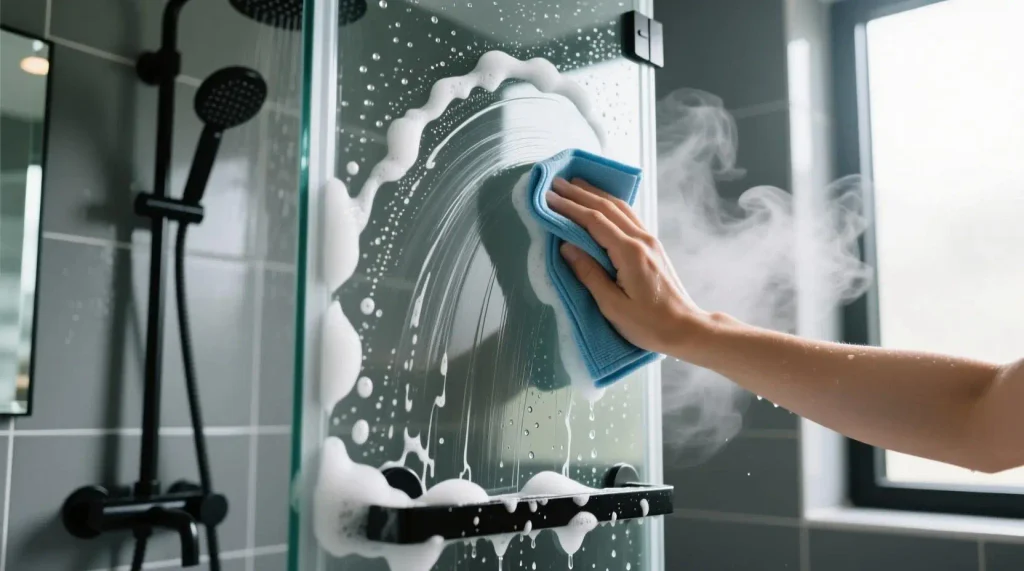
Shower glass doors are particularly likely to show soap scum because water droplets, soap residue, and body oils repeatedly collect on the surface.
Step-by-Step Cleaning Instructions
- Inspect the glass: Check whether it has a protective coating or special manufacturer finish.
- Remove loose residue: Rinse the glass with clean water.
- Choose a suitable cleaner: Start with mild dish soap and warm water.
- Apply the solution: Use a soft microfiber cloth or non-abrasive sponge.
- Clean gently: Work across the cloudy areas without applying excessive pressure.
- Rinse thoroughly: Remove all loosened residue and cleaning product.
- Dry the glass: Use a suitable squeegee followed by a clean microfiber cloth.
If mineral deposits remain, a glass-compatible hard-water cleaner may be appropriate. Vinegar may help with certain deposits on ordinary uncoated glass, but check the manufacturer’s instructions first.
Important: Do not use rough scouring pads or abrasive tools on shower glass. Protective coatings may require special cleaning products.
For more detailed instructions, read our related guide: How to Remove Cloudy Film From Glass Shower Doors.
How to Remove Soap Scum from Bathroom Tiles

Soap scum can collect on bathroom wall tiles, particularly around showers, bathtubs, and frequently used areas.
Step-by-Step Cleaning Instructions
- Identify whether the tiles are ceramic, porcelain, or natural stone.
- Remove loose dirt by rinsing the tiles.
- Prepare a mild dish soap and warm water solution.
- Apply it with a soft sponge.
- Gently clean the affected areas.
- Use a suitable soft brush for compatible grout.
- Rinse thoroughly with clean water.
- Dry the tiles using a clean cloth.
What About Natural Stone Tiles?
Natural stone requires additional care.
Avoid vinegar, lemon juice, and other acidic cleaners on marble, limestone, travertine, and other acid-sensitive stone.
Instead:
- Use a pH-neutral cleaner specifically approved for the stone.
- Follow the stone manufacturer’s instructions.
- Use a soft cloth or sponge.
- Avoid abrasive cleaning powders.
- Rinse and dry as recommended.
If soap scum has accumulated around grout lines, clean gently rather than aggressively scrubbing the grout.
How to Remove Soap Scum from a Bathtub
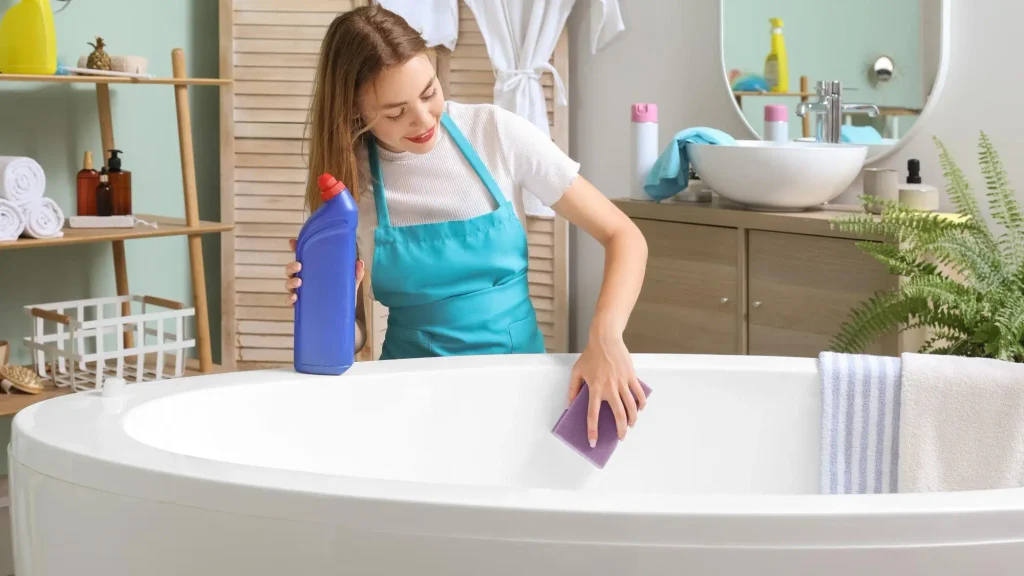
Soap scum can create a slippery or sticky coating inside bathtubs. The safest cleaning method depends on the bathtub material.
Cleaning an Acrylic Bathtub
Acrylic bathtubs can be scratched by abrasive cleaning materials.
- Rinse the bathtub with warm water.
- Apply a mild cleaner approved for acrylic.
- Wipe gently using a soft cloth or sponge.
- Pay attention to corners and areas around the drain.
- Rinse thoroughly.
- Dry with a clean microfiber cloth.
Avoid steel wool, abrasive powders, and aggressive scrubbing.
Cleaning a Fiberglass Bathtub
Fiberglass surfaces can also be damaged by abrasive cleaning tools.
- Choose a cleaner labelled safe for fiberglass.
- Use a soft sponge.
- Clean in gentle circular motions.
- Rinse away all product residue.
- Dry with a soft cloth.
Cleaning an Enamel Bathtub
Enamel finishes need gentle cleaning to prevent scratching and damage.
Use a manufacturer-approved bathroom cleaner and a non-abrasive cloth. Avoid harsh scouring pads and strong chemicals unless specifically approved.
Cleaning a Porcelain Bathtub
For porcelain, choose a suitable cleaner according to whether the surface is glazed, unglazed, or coated.
Apply the cleaner as directed, wipe gently, rinse, and dry.
Remember: Acrylic, fiberglass, enamel, and porcelain are different materials. Do not assume that a cleaning product suitable for one bathtub is suitable for all four.
How to Remove Soap Scum from Shower Walls

Shower walls can collect soap residue, shampoo, conditioner, and body oils.
The correct method depends on the wall material.
| Shower wall material | Recommended approach |
|---|---|
| Ceramic tiles | Mild compatible bathroom cleaner and soft sponge |
| Porcelain tiles | Surface-approved cleaner and gentle wiping |
| Acrylic panels | Acrylic-safe non-abrasive cleaner |
| Fiberglass panels | Fiberglass-approved cleaner and soft cloth |
| Natural stone | Stone-safe pH-neutral cleaner |
Cleaning Steps
- Identify the shower wall material.
- Remove loose dirt with clean water.
- Apply an appropriate cleaning solution.
- Allow the product to work according to its instructions.
- Gently wipe the affected areas.
- Rinse thoroughly.
- Dry the surface where practical.
Avoid allowing cleaning products to run onto nearby materials that may be sensitive to them.
How to Remove Soap Scum from Faucets and Bathroom Fixtures
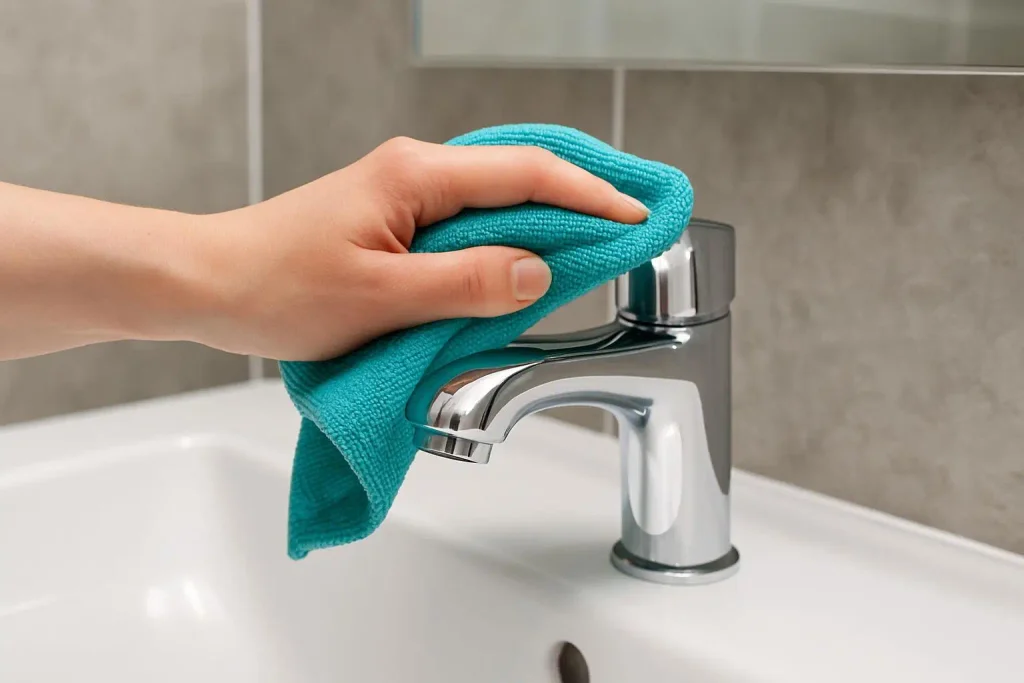
Soap residue and mineral deposits can collect around faucet bases, handles, and other bathroom hardware.
However, different finishes require different cleaning methods.
Chrome Fixtures
Use a mild, manufacturer-approved cleaner and a soft microfiber cloth. Rinse and dry to reduce water spots.
Stainless Steel Fixtures
Clean using a suitable stainless-steel cleaner or mild soapy water. Wipe in the direction recommended by the manufacturer and dry thoroughly.
Brass Fixtures
Some brass fixtures have protective lacquer or decorative coatings. Use only a cleaner approved for the particular finish.
Nickel Finishes
Brushed and polished nickel may require different care. Avoid acidic products and abrasive scrubbers unless the manufacturer specifically approves them.
Black or Decorative Finishes
Matte black and other decorative finishes can be particularly sensitive to harsh chemicals.
Use a soft damp cloth and manufacturer-approved cleaner. Avoid abrasive pads and unapproved descalers.
How to Remove Stubborn Soap Scum Buildup
Old soap scum may require more than one cleaning attempt.
Instead of immediately using stronger chemicals, follow a careful approach.
- Identify the surface: Determine whether you are cleaning glass, ceramic, acrylic, stone, or metal.
- Identify the residue: Check whether it is greasy soap scum, mineral deposits, or a combination.
- Choose the correct cleaner: Use a product specifically suitable for the material.
- Apply correctly: Follow the manufacturer’s recommended instructions.
- Allow contact time: Never exceed the recommended time.
- Clean gently: Use a compatible non-abrasive sponge or cloth.
- Repeat if appropriate: Repeat gentle cleaning if the product instructions allow it.
- Rinse and dry: Remove all remaining cleaner and residue.
If the buildup does not improve, it may be limescale, mineral etching, damaged coating, or another surface problem.
Do not continue aggressive scrubbing in an attempt to remove permanent damage.
Common Soap Scum Cleaning Mistakes to Avoid
Avoid these common mistakes when cleaning bathroom surfaces.
- Using abrasive scrubbers: They can scratch delicate surfaces.
- Using vinegar on marble: Acidic cleaners can damage natural stone.
- Ignoring surface compatibility: Different materials require different products.
- Scrubbing shower glass aggressively: This can damage protective coatings.
- Using too much cleaning product: Excess residue can leave streaks.
- Leaving cleaner on too long: This may damage certain finishes.
- Using sharp metal objects: They can scratch glass, tiles, and fixtures.
- Ignoring product instructions: Always follow the label.
- Failing to rinse: Remaining cleaner can leave another layer of residue.
- Mixing cleaning chemicals: This can produce dangerous reactions.
Important Cleaning Safety Warning
Never mix bleach with vinegar, ammonia, acids, toilet cleaners, or other cleaning products. Dangerous gases can be released.
For additional guidance, read Health Canada’s household chemical safety guidelines to learn about the safe handling and storage of household cleaning products.
Always:
- Read cleaning product labels.
- Wear gloves when recommended.
- Open windows or run the bathroom exhaust fan.
- Keep cleaning products away from children and pets.
- Store products in their original labelled containers.
- Rinse surfaces appropriately before using a different product.
Safety references: Poison Control and Health Canada. Poison Control+2
How Often Should You Remove Soap Scum?
There is no single cleaning schedule suitable for every bathroom.
Cleaning frequency depends on water hardness, bathroom usage, the number of people using the bathroom, and the type of soap and body wash.
A practical routine could look like this:
| Cleaning activity | Suggested routine |
|---|---|
| Rinse shower walls | After showering when practical |
| Wipe shower glass | After use |
| Clean visible soap residue | When noticed |
| Clean bathtub | Regularly, depending on use |
| Clean bathroom fixtures | During routine bathroom cleaning |
| Deep-clean affected surfaces | As needed |
If your bathroom has hard water, you may need to clean certain surfaces more frequently.
How to Prevent Soap Scum from Building Up
Removing soap scum is easier when you prevent excessive buildup in the first place.

Try these practical prevention tips.
1. Rinse Shower Surfaces After Use
Rinse away visible soap and shampoo residue before it dries.
2. Use a Shower Squeegee
Remove excess water from shower glass after bathing.
3. Dry Bathroom Fixtures
Wipe faucets and other fixtures with a microfiber cloth to reduce water spots and residue.
4. Clean Bathtubs Regularly
Remove visible soap residue before it accumulates.
5. Consider Your Soap Products
Some liquid soaps and body washes may leave less traditional soap scum than certain bar soaps. However, they can still leave product residue.
6. Improve Bathroom Ventilation
Use an exhaust fan or open a window where appropriate to help moisture escape.
7. Address Hard Water Problems
If mineral deposits appear throughout your home, consider checking your water hardness and exploring appropriate water-treatment options.
8. Follow Manufacturer Cleaning Recommendations
Using the correct cleaner for each surface helps protect bathroom materials and finishes.
Small maintenance habits can make bathroom cleaning easier and reduce the amount of stubborn residue that develops over time.
Frequently Asked Questions About Removing Soap Scum
1. What Is the Easiest Way to Remove Soap Scum?
Start with mild dish soap and warm water. Apply the solution using a soft sponge, gently wipe the surface, rinse thoroughly, and dry. Use a different compatible cleaner if the residue remains.
2. What Removes Stubborn Soap Scum?
A bathroom cleaner specifically formulated for soap scum may help remove stubborn buildup. Choose one suitable for your surface and follow its instructions.
3. Does Vinegar Remove Soap Scum?
Vinegar can help dissolve certain mineral deposits and loosen some soap scum. However, it should not be used on marble, limestone, travertine, or other acid-sensitive surfaces.
4. Can Baking Soda Remove Soap Scum?
Baking soda may help with some residue through gentle mechanical cleaning. However, it can be abrasive on certain materials and finishes. Test compatibility before use.
5. How Do You Remove Soap Scum from Shower Glass?
Start with mild dish soap and warm water. Use a microfiber cloth or non-abrasive sponge, rinse thoroughly, and dry with a squeegee. Check protective glass coating instructions before using stronger cleaners.
6. How Do You Remove Soap Scum from Bathroom Tiles?
Use a suitable tile cleaner and soft sponge. Clean gently, rinse thoroughly, and dry. Natural stone tiles require a stone-safe cleaner.
7. How Do You Remove Soap Scum from a Bathtub?
Identify the bathtub material first. Apply an approved non-abrasive cleaner, wipe gently, rinse thoroughly, and dry.
8. How Do You Remove Soap Scum from Shower Walls?
Use a cleaner designed for the wall material. Gently wipe the affected areas and rinse away the residue.
9. How Do You Remove Soap Scum from Faucets?
Use a mild cleaner approved for the faucet finish. Wipe with a soft microfiber cloth, rinse if instructed, and dry.
10. What Is the Difference Between Soap Scum and Hard Water Stains?
Soap scum forms when soap interacts with hard-water minerals. Hard water stains are mineral deposits left behind when water evaporates. Both can appear together.
11. Why Does Soap Scum Keep Coming Back?
Repeated soap use, hard water, incomplete rinsing, and inadequate drying can cause soap scum to return.
12. Can Dish Soap Remove Soap Scum?
Yes, mild dish soap can help loosen ordinary soap residue and oily buildup. Heavy mineral deposits may require a different compatible cleaner.
13. How Often Should You Clean Soap Scum from a Shower?
Clean visible residue regularly. The frequency of deeper cleaning depends on shower usage, water hardness, and how quickly buildup develops.
14. Can Vinegar Damage Bathroom Surfaces?
Yes. Vinegar can damage marble, limestone, travertine, and other acid-sensitive materials. It may also be unsuitable for certain protective coatings and decorative finishes.
15. How Can You Prevent Soap Scum Buildup?
Rinse shower surfaces, use a squeegee, dry fixtures, clean regularly, and address hard water where appropriate.
Conclusion
Soap scum can make shower glass, bathroom tiles, bathtubs, shower walls, and faucets look dirty even when you clean your bathroom regularly. Fortunately, choosing the correct cleaning method can help remove buildup without unnecessarily damaging bathroom surfaces.
The most important step in learning how to remove soap scum is identifying the surface material before selecting a cleaning solution. Mild dish soap and warm water are useful starting points for ordinary residue, while suitable bathroom cleaners may help with more stubborn deposits.
Avoid aggressive scrubbing, unsuitable acidic products, and dangerous chemical combinations. Always follow manufacturer instructions, rinse surfaces thoroughly, and maintain a regular bathroom cleaning routine.
With a few simple habits, you can reduce soap scum buildup and keep your bathroom looking cleaner for longer.
For more practical cleaning solutions, explore the Cleaning Fixes guides on Fix The Annoying.